Miyerkules, Enero 4, 2017

STORY OF GILGAMESH


Gilgamesh Visual Arts Ancient Places and/or Civilizations Social Studies World History


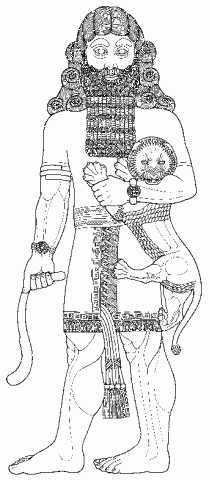
GILGAMESH, 
ONE OF THE GIANTS OF ANCIENT TIMES


ENKIDU


                                                           CITY OF UNUG
                        GILGAMESH , THE KING OF THE CITY OF UNUG
====================

Genesis 6:4


“There were giants in the earth in those days; and also after that, when the sons of God came in unto the daughters of men, and they bare children to them, the same became mighty men which were of old, men of renown.”
===========================


THE STORY OF THE FALL OF EMPIRE OF SUMERIA 
WHEN THE KINGDOM OF AILAM (ELAM)
ATTACKED THE CITIES OF UR AND URUK
AND THE ESTABLISHMENT OF BABYLON AS THE NEW CITY OF ATHURA (ACCAD) KINGDOM

HUMBABA= KING OF AILAM
GILGAMESH - KING OF URUK

==================

================
==================

THE FALL OF THE DYNASTY OF UR
=========================

DESTRUCTION OF THE CITY OF URUK BY THE ARMY OF AILAM


Gilgamesh. the king who knew the ANCIENT countries of the world.

Gilgamesh had the perfect body.

In Uruk he built walls, a great rampart, , and for Ishtar . Look at it still today: the outer wall where the cornice runs, it shines with the brilliance of copper; and the inner wall, it has no equal. Touch the threshold, it is ancient. Approach Eanna the dwelling of Ishtar, our lady of love and war, the like of which no latter-day king, no man alive can equal. Climb upon the wall of Uruk; walk along it, I say; regard the foundation terrace and examine the masonry: is it not burnt brick and good

THE COMING OF ENKIDU


GILGAMESH went abroad in the world, but he met with none who could withstand his arms till be came to Uruk. But the men of Uruk muttered in their houses, 'Gilgamesh sounds the tocsin for his amusement, his arrogance has no bounds by day or night. No son is left with his father, for Gilgamesh takes them all,, even the children; yet the king should be a shepherd to his people. His lust leaves no virgin to her lover, neither the warrior's daughter nor the wife of the noble; yet this is the shepherd of the city, wise, comely, and resolute.'

Enkidu ate grass in the hills with the gazelle and lurked with wild beasts at the water-holes; he had joy of the water with the herds of wild game. But there was a trapper who met him one day face to face at the drinking-hole, for the wild game had entered Ills territory. On three days he met him face to face, and the trapper was frozen with fear. He went back to his house with the game that he had caught, and he was dumb, benumbed with terror. His face was altered like that of one who has made a long journey. With awe in his heart he spoke to his father: 'Father, there is a man, unlike any other, who comes down from the hills. He is the strongest in the world, he is like an immortal from heaven. He ranges over the hills with wild beasts and cats grass; he ranges through your land and comes down to the wells. I am afraid and dare not go near him. He fills in the pits which I dig and tears up my traps set for the game; lie helps the beasts to escape and now they slip through my fingers.'

His father opened his mouth and said to the trapper, 'My son in Uruk lives Gilgamesh; no one has ever prevailed against him, he is strong as a star from heaven. Go to Uruk, find Gilgamesh, extol the strength of this wild man. Ask him to give you a harlot, a wanton from the temple of love; return with her, and let her  woman's power overpower this mail. When next he comes down to drink at the wells she will be there, stripped naked; and when he sees her beckoning he will embrace her, and then the wild beasts will reject him.'

So the trapper set out on his journey to Uruk and addressed himself to Gilgamesh saying, 'A man unlike any other is roaming now in the pastures; he is as strong as a star from heaven and I am afraid to approach him. He helps the wild game to escape; he fills in my pits and pulls up my traps.' Gilgamesh said, 'Trapper, go back, take with you a harlot, a child of pleasure. At the drinking-hole she will strip, and when he sees her beckoning he will embrace her and the game of the wilderness will surely reject him. '

Now the trapper returned, taking the harlot with him. After a three days' journey they came to the drinking-hole, and there they sat down; the harlot and the trapper sat facing one another and waited for the game to come. For the first day and for the second day the two sat waiting, but on the third day the herds came; they came down to drink and Enkidu was with them. The small wild creatures of the plains were glad of the water, and Enkidu with them, who ate grass with the gazelle and was born in the hills; and she saw him, the savage man, come from far-off in the hills. The trapper spoke to her: 'There he is. Now, woman, make your breasts bare, have no shame, do not delay but welcome his love. Let him see you naked, let him possess your body. When he comes near uncover yourself and lie with him; teach him, the savage man, your woman's art, for when he murmurs love to you the wild beasts that shared his life in the hills will reject him.'

She was not ashamed to take him, she made herself naked and welcomed his eagerness; as he lay on her murmuring love she taught him the woman's art. For six days and seven nights they lay together, for Enkidu had forgotten his home in the hills; but when he was satisfied lie went back to the wild beasts. Then, when the gazelle saw him, they bolted away; when the wild creatures saw him they fled. Enkidu would have followed, but his body was bound as though with a cord, his knees gave way when lie started to run, his swiftness was gone. And now the wild creatures had all fled away; Enkidu was grown weak, for wisdom was in him, and the thoughts of a man were in his heart. So he returned and sat down at the woman's feet, and listened intently to what she said. 'You are wise, Enkidu, and now you have become like a god. Why do you want to run wild with the beasts in the hills? Come with me. I will take you to strong-walled Uruk, to the blessed temple of Ishtar and of Anu, of love and of heaven: there Gilgamesh lives, who is very strong, and like a wild bull he lords it over men.'

When she had spoken Enkidu was pleased; he longed for a comrade, for one who would understand his heart. ' Come, woman, and take me to that holy temple, to the house of Anu and of Ishtar, and to the place where Gilgamesh lords it over the people. I will challenge him boldly, I will cry out aloud in Uruk, " I am the strongest here, I have come to change the old order, I am he who was born in the hills, I am he who is strongest of all."'

She said, 'Let us go, and let him see your face. I know very well where Gilgamesh is in great Uruk. O Enkidu, there all the people are dressed in their gorgeous robes, every day is holiday, the young men and the girls are wonderful to see. How sweet they smell! All the great ones are roused from their beds. O Enkidu, you who love life, I will show you Gilgamesh, a man of many moods; you shall look at him well in his radiant manhood. His body is perfect in strength and maturity; he never rests by night or day. He is stronger than you, so leave your boasting. Shamash the glorious sun has given favours to Gilgamesh, and Anu of the heavens, and Enlil, and Ea the wise has given him deep understanding. I tell you, even before you have left the wilderness, Gilgamesh will know in his dreams that you are coming.'

gilgamesh

ninsun. mother of gilgamesh 
Then Ninsun, who is well-beloved and wise, said to Gilgamesh, 'This star of heaven which descended like a meteor from the sky; which you tried to lift, but found too heavy, when you tried to move it it would not budge, and so you brought it to my feet; I made it for you, a goad and spur, and you were drawn as though to a woman. This is the strong comrade, the one who brings help to his friend in his need. He is the strongest of wild creatures, the stuff of Anu; born in the grass-lands and the wild hills reared him; when you see him you will be glad; you will love him as a woman and he will never forsake you. This is the meaning of the dream.' 

Gilgamesh said, 'Mother, I dreamed a second dream. In the streets of strong-walled Uruk there lay an axe; the shape of it was strange and the people thronged round. I saw it and was glad. I bent down, deeply drawn towards it; I loved it like a woman and wore it at my side.' Ninsun answered , That axe, which you saw, which drew you so powerfully like love of a woman, that is the comrade whom I give you, and he will come in his strength like one of the host of heaven. He is the brave companion who rescues his friend in necessity.' Gilgamesh said to his mother, 'A friend, a counsellor has come to me from Enlil, and now I shall befriend and counsel him.' So Gilgamesh told his dreams; and the harlot retold them to Enkidu


And now she said to Enkidu, ' Why do you yearn to run wild again with the beasts in the hills? Get up from the ground, the bed of a shepherd.' He listened to her words with care. It was good advice that she gave. She divided her clothing in two and with the one half she clothed him and with the other herself, and holding his hand she led him like a child to the sheepfolds, into the shepherds' tents. There all the shepherds crowded round to see him, they put down bread in front of him, but Enkidu could only suck the milk of wild animals. He fumbled and gaped, at a loss what to do or how he should eat the bread and drink the strong wine. Then the woman said , Enkidu, eat broad, it is the staff of life; drink the wine, it is the custom of the land.' So he ate till he was full and drank strong wine, seven goblets. He became merry, his heart exulted and his face shone. He rubbed down the matted hair of his body and anointed himself with oil. Enkidu had become a man; but when he had put on man's clothing he appeared like a bridegroom. He took arms to hunt the lion so that the shepherds could rest at night. He caught wolves and lions and the herdsmen lay down in peace; for Enkidu was their watchman, that strong man who had no rival.

He was merry living with the shepherds, till one day lifting his eyes he saw a man approaching. He said to the harlot, 'Woman, fetch that man here. Why has he come? I wish to know his name.' She went and called the man saying, 'Sir, where are you going on this weary journey? The man answered, saying to Enkidu, 'Gilgamesh has gone into the marriage-house and shut out the people. He does strange things in Uruk, the city of great streets. At the roll of the drum work begins for the men, and work for the women. Gilgamesh the king is about to celebrate marriage with the Queen of Love, and he still demands to be first with the bride, the king to be first and the husband to follow, for that was ordained by the gods from his birth, from the time the umbilical cord was cut. But now the drums roll for the choice of the bride and the city groans.' At these words Enkidu turned white in the face. 'I will go to the place where Gilgamesh lords it over the people, I will challenge him boldly, and I will cry aloud in Uruk, "I have come to change the old order, for I am the strongest here."'

Now Enkidu strode in front and the woman followed behind. He entered Uruk, that great market, and all the folk thronged round him where he stood in the street in strong-walled Uruk. The people jostled; speaking of him they said, 'He is the spit of Gilgamesh.' 'He is shorter.' 'He is bigger of bone." This is the one who was reared on the milk of wild beasts. His is the greatest strength.' The men rejoiced: 'Now Gilgamesh has met his match. This great one, this hero he is a match even for Gilgamesh.'

THE FOREST JOURNEY

In the mountain, Gilgamesh dreamed and Enkidu said , The meaning of the dream is this.  kingship, such is your destiny, everlasting life is not your destiny. Because of this do not be sad at heart, do not be grieved or oppressed. He has given you power to bind and to loose, to be the darkness and the light of mankind. He has given you unexampled supremacy over the people, victory in battle from which no fugitive returns, in forays and assaults from which there is no going back. But do not abuse this power, deal justly with your servants in the palace

The eyes of Enkidu were full of tears and his heart was sick. He sighed bitterly and Gilgamesh met his eye and said, 'My friend, why do you sigh so bitterly? But Enkidu opened his mouth and said, '1 am weak, my arms have lost their strength, the cry of sorrow sticks in my throat, I am oppressed by idleness.' It was then that the lord Gilgamesh turned his thoughts to the Country of the Living; on the Land of Cedars the lord Gilgamesh reflected. He said to his servant Enkidu, 'I have not established my name stamped on bricks as my destiny decreed; therefore I will go to the country where the cedar is felled. I will set up my name in the place where the names of famous men arc written, and where no man's name is written yet I will raise a monument to the gods. Because of the evil that in the land, we will go to the forest and destroy the evil; for in the forest lives Humbaba whose name is "Hugeness", a ferocious giant.' But Enkidu sighed bitterly and said, 'When I went with the wild beasts ranging through the wilderness I discovered the forest; its length is ten thousand leagues in every direction. Enlil has appointed Humbaba to guard it and armed him in sevenfold terrors, terrible to all flesh is Humbaba. When he roars it is like the torrent of the storm, his breath is like fire, and his jaws are death itself. He guards the cedars so well that when the wild heifer stirs in the forest, though she is sixty leagues distant, he hears her. What man would willingly walk into that country and explore its depths? I tell you, weakness overpowers whoever goes near it: it is not an equal struggle when one fights with Humbaba;. he is a great warrior, a battering-ram. Gilgamesh, the watchman of the forest never sleeps.'
Gilgamesh replied: 'Where is the man who can clamber to heaven? Only the gods live forever with glorious Shamash, but as for us men, our days are numbered, our occupations are a breath of wind. How is this, already you are afraid! I will go first although I am your lord, and you may safely call out, “Forward, there is nothing to fear!" Then if I fall I leave behind me a name that endures; men will say of me, "Gilgamesh has fallen in fight with ferocious Humbaba." Long after the child has been born in my house, they will say it, and remember.' Enkidu spoke again to Gilgamesh

Gilgamesh took up a kid, white without spot, and a brown one with it; he held them against his breast, and lie carried them into the presence of the sun. He took in his hand his silver sceptre and he said to glorious Shamash, 'I am going to that country, I am going; my hands supplicate, so let it be well with my soul and bring me back to the quay of Uruk. Grant, I beseech, your protection, and let the omen be good.'  Gilgamesh, you are strong, but what is the Country of the Living to you?' 

Here in the city man dies oppressed at heart, man perishes with despair in his heart. I have looked over the wall and I see the bodies floating on the river, and that will be my lot also. Indeed I know it is so, for whoever is tallest among men cannot reach the heavens, and the greatest cannot encompass the earth. Therefore I would enter that country: because I have not established my name stamped on brick as my destiny decreed, I will go to the country where the cedar is cut. I will set up my name where the names of famous men arc written; and where no man's name is written I will raise a monument to the gods.' The tears ran down his face and he said, 'Alas, it is a long journey that I must take to the Land of Humbaba. If this enterprise is not to be accomplished, why did you move me, Shamash, with the restless desire to perform it? How can I succeed if you will not succour me? If I die in that country I will die without rancour, but if I return I will make a glorious offering of gifts

 He went to the forge and said, 'I will give orders to the armourers; they shall cast us our weapons while we watch them.' So they gave orders to the armourers and the craftsmen sat down in conference. They went into the groves of the plain and cut willow and box-wood; they cast for them axes of nine score pounds, and great swords they cast with blades of six score pounds each one, with pommels and hilts of thirty pounds. They cast for Gilgamesh the axe 'Might of Heroes' and the bow of Anshan; and Gilgamesh was armed and Enkidu; and the weight of the arms they carried was thirty score pounds.


                               Humbaba
The people collected and the counsellors in the streets and in the market-place of Uruk; they came through the gate of seven bolts and Gilgamesh spoke to them in the market-place: 'I, Gilgamesh, go to see that creature of whom such things are spoken, the rumour of whose name fills the world. I will conquer him in his cedar wood and show the strength of the sons of Uruk, all the world shall know of it. I am committed to this enterprise: to climb the mountain, to cut down the cedar, and leave behind me an enduring name.' The counsellors of Uruk, the great market, answered him I 'Gilgamesh, you are young, your courage carries you too far, you cannot know what  this enterprise means which you plan. We have heard that Humbaba is not like men who die, his weapons are such that none can stand against them; the forest stretches for ten thousand leagues in every direction; who would willingly go down to explore its depths? As for Humbaba, when be roars it is like the torrent of the storm, his breath is like fire and his jaws are death itself. Why do you crave to do this thing, Gilgamesh? It is no equal struggle when one fights with Humbaba, that batteringram!


War of kingdom of Ailam (Elam) led by King Humbaba against Uruk 
When he heard these words of the counsellors Gilgamesh looked at his friend and laughed, 'How shall I answer them; shall I say I am afraid of Humbaba, I will sit at home all the rest of my days? 'Then Gilgamesh opened his mouth again and said to Enkidu, 'My friend, let us go to the Great Palace, to Egalmah, and stand before Ninsun the queen. Ninsun is wise with deep knowledge, she will give us counsel for the road we must go.' They took each other by the hand as they went to Egalmah, and they went to Ninsun the great queen. Gilgamesh approached, he entered the palace and spoke to Ninsun. 'Ninsun, will you listen to me; I have a long journey to go, to the Land of Humbaba, I must travel an unknown road and fight a strange battle. From the day I go until I return, till I reach the cedar forest and destroy the evil 

And now they brought to them the weapons, they put in their hands the great swords in their golden scabbards, and the bow and the quiver. Gilgamesh took the axe, be slung the quiver from his shoulder, and the bow of Anshan, and buckled the sword to his belt; and so they were armed and ready for the journey. Now all the people came and pressed on them and said, 'When will you return to the city?' The counsellors blessed Gilgamesh and warned him, 'Do not trust too much in your own strength, be watchful, restrain your blows at first. The one who goes in front protects 

his companion; the good guide who knows the way guards his friend. Let Enkidu lead the way, he knows the road to the forest, he has seen Humbaba and is experienced in battles; let him press first into the passes, let him be watchful and look to himself. Let Enkidu protect his friend, and guard his companion, and bring him safe through the pitfalls of the road. We, the counsellors of Uruk entrust our king to you, O Enkidu; bring him back safely to us.' Again to Gilgamesh they said, 'May Shamash give you your heart's desire, may he let you see with your eyes the thing accomplished which your lips have spoken; may he open a path for you where it is blocked, and a road for your feet to tread. May he open the mountains for your crossing, and may the nighttime bring you the blessings of night, and Lugulbanda, your guardian god, stand beside you for victory. May you have victory in the battle as though you fought with a child. Wash your feet in the river of Humbaba to which you are journeying; in the evening dig a well, and let there always be pure water in your water-skin. Offer cold water  and do not forget Lugulbanda.'

Then Enkidu opened his mouth and said, 'Forward, there is nothing to fear. Follow me, for I know the place where Humbaba lives and the paths where he walks. Let the counsellors go back. Here is no cause for fear.' When the counsellors heard this they sped the hero on his way. 'Go, Gilgamesh, may your guardian god protect you on the road and bring you safely back to the quay of Uruk.'

After twenty leagues they broke their fast; after another thirty leagues they stopped for the night. Fifty leagues they walked in one day; in three days they had walked as much as a journey of a month and two weeks. They crossed seven mountains before they came to the gate of the forest. Then Enkidu called out to Gilgamesh, Do not go down into the forest; when I opened the gate my hand lost its strength.' Gilgamesh answered him, 'Dear friend, do not speak like a coward. Have we got the better of so many dangers and travelled so far, to turn back at last? You, who are tried in wars and battles, hold close to me now and you will feel no fear of death; keep beside me and your weakness will pass, the trembling will leave your hand. Would my friend rather stay behind? No, we will go down together into the heart of the forest. Let your courage be roused by the battle to come; forget death and follow me, a man resolute in action, but one who is not foolhardy. When two go together each will protect himself and shield his companion, and if they fall they leave an enduring name.'
Together they went down into the forest and they came to the green mountain. There they stood still, they were struck dumb; they stood still and gazed at the forest. They saw the height of the cedar, they saw the way into the forest and the track where Humbaba was used to walk. The way was broad and the going was good. They gazed at the mountain of cedars, the dwelling-place of the gods and the throne of Ishtar. The hugeness of the cedar rose in front of the mountain, its shade was beautiful, full of comfort; mountain and glade were green with brushwood.

There Gilgamesh dug a well before the setting-sun. He went up the mountain and poured out fine meal on the ground and said, 'O mountain, dwelling of the gods, bring me a favourable dream.' Then they took each other by the hand and lay down to sleep;

Enkidu said, 'Dear friend, we are travelling That wild bull which you saw is Protector; in our moment of peril he will take our hands. The one who gave water from his water-skin, that is your own god who cares for your good name, your Lugulbanda. United with him, together we will accomplish a work the fame of which will never die.'

Then Enkidu the child of the plains said, 'Let us go down from the mountain and talk this thing over together.' He said to Gilgamesh the young god, 'Your dream is good, your dream is excellent, the mountain which you saw is Humbaba. Now, surely, we will seize and kill him, and throw his body down as the mountain fell on the plain.'


The next day after twenty leagues they broke their fast, and after another thirty they stopped for the night. They dug a well before the sun had set and Gilgamesh ascended the mountain. He poured out fine meal on the ground and said, 'O mountain, dwelling of the gods, send a dream for Enkidu, make him a favourable dream.' The mountain fashioned a dream for Enkidu; it came, an ominous dream; a cold shower passed over him, it caused him to cower like the mountain barley under a storm of rain. But Gilgamesh sat with his chin on his knees till the sleep which flows over all mankind lapped over him. Then, at midnight, sleep left him; he got up and said to his friend, 'Did you call me, or why did I wake? Did you touch me, or why am I terrified? Did not some god pass by, for my limbs are numb with fear? My friend, I saw a third dream and this dream was altogether frightful. The heavens roared and the earth roared again, daylight failed and darkness fell, lightnings flashed, fire blazed Out, the clouds lowered, they rained down death. Then the brightness departed, the fire went out, and all was turned to ashes fallen about us. Let us go down from the mountain and talk this over, and consider what we should do.'

When they had come down from the mountain Gilgamesh seized the axe in his hand: he felled the cedar. When Humbaba heard the noise far off he was enraged; he cried out,' Who is this that has violated my woods and cut down my cedar?' But

'Go forward, do not be afraid.' But now Gilgamesh was overcome by weakness, for sleep had seized him suddenly, a profound sleep held him; he lay on the ground, stretched out speechless, as though in a dream. When Enkidu touched him he did not rise, when he spoke to him he did not reply. 'O Gilgamesh, Lord of the plain of Kullab, the world grows dark, the shadows have spread over it, now is the glimmer of dusk. Shamash has departed, his bright head is quenched in the bosom of his mother Ningal. O Gilgamesh, how long will you lie like this, asleep? Never let the mother who gave you birth be forced in mourning into the city square.'

At length Gilgamesh heard him; he put on his breastplate, 'The Voice of Heroes', of thirty shekels' weight; he put it on as though it had been a light garment that he carried, and it covered him altogether. He straddled the earth like a bull that snuffs the ground and his teeth were clenched. 'By the life of my mother Ninsun who gave me birth, and by the life of my father, divine Lugulbanda, let me live to be the wonder of my mother, as when she nursed me on her lap.' A second time he said to him, 'By the life of Ninsun my mother who gave me birth, and by the life of my father, divine Lugulbanda, until we have fought this man, if man he is, this god, if god lie is, the way that I took to the Country of the Living will not turn back to the city.' 

Then Enkidu, the faithful companion, pleaded, answering him, 'O my lord, you do not know this monster and that is the reason you are not afraid. I who know him, I am terrified. His teeth are dragon's fangs, his countenance is like a lion, his charge is the rushing of the flood, with his look he crushes alike the trees of the forest and reeds in the swamp. O my Lord, you may go on if you choose into this land, but I will go back to the city. I will tell the lady your mother all your glorious deeds till she shouts for joy: and then I will tell the deatil that followed till she weeps for bitterness.' But Gilgamesh said, 'Immolation and sacrifice are not yet for me, the boat of the dead shall not go down, nor the three-ply cloth be cut for my shrouding. Not yet will my people be desolate, nor the pyre be lit in my house and my dwelling burnt on the fire. 

So he felled the first cedar and they cut the branches and laid them at the foot of the mountain. At the first stroke Humbaba blazed Out, but still they advanced. They felled seven cedars and cut and bound the branches and laid them at the foot of the mountain, and seven times Humbaba loosed his glory on them. As the seventh blaze died out they reached his lair. He slapped his thigh in scorn. He approached like a noble wild bull roped on the mountain, a warrior whose elbows are bound together. The tears started to his eyes and he was pale, 'Gilgamesh, let me speak. I have never known a mother, no, nor a father who reared me.. I was born of the mountain, he reared me, and Enlil made me the keeper of this forest. Let me go free, Gilgamesh, and I will be your servant, you shall be my lord; all the trees of the forest that I tended on the mountain shall be yours. I will cut them down and build you a palace.' He took him by the hand and led him to his house, so that the heart of Gilgamesh was moved with compassion. He swore by the heavenly life, by the earthly life, by the underworld itself: 'O Enkidu, should not the snared bird return to its nest and the captive man return to his mother's arms?' Enkidu answered, 'The strongest of men will fall to fate if he has no judgement. Namtar, the evil fate that knows no distinction between men, will devour him. If the snared bird returns to its nest, if the captive man returns to his mother's arms, then you my friend will never return to the city where the mother is waiting who gave you birth. He will bar the mountain road against you, and make the pathways impassable.'

Gilgamesh listened to the word of his companion, he took the axe in his hand, he drew the sword from his belt, and he struck Humbaba with a thrust of the sword to the neck, and Enkidu his comrade struck the second blow. At the third blow Humbaba fell. Then there followed confusion for this was the guardian of the forest whom they had felled to the ground. For as far as two leagues the cedars shivered when Enkidu


STORY OF SARGON


====================
All that now remained for Tiglath-Pileser to do was to reduce Babylonia as he had reduced Syria. In b.c. 731, accordingly, he marched again into Chaldæa. Ukin-ziru, the Babylonian king, was slain, Babylon and other great cities were taken, and in b.c. 729, under his original name of Pul, Tiglath-Pileser assumed the title of 'king of Sumer (Shinar) and Accad.'


Tiglath-Pileser

He lived only two years after this, and died in b.c. 727, when the crown was seized by Elulæos of Tinu, who took the name of Shalmaneser IV. Shalmaneser's short reign was signalised by an unsuccessful attempt to capture Tyre, and by the beginning of a war against the kingdom of Israel. But the siege of Samaria was hardly commenced when Shalmaneser died, or was murdered, in b.c. 722, and was succeeded by another usurper who assumed the name of Sargon, one of the most famous of [Pg 38]the early Babylonian kings. Sargon in his inscriptions claims royal descent, but the claim was probably without foundation. He proved to be an able general, though his inscriptions show that he continued to the last to be a rough but energetic soldier who had perhaps risen from the ranks.


BATLE OF Samaria Two years after his accession (b.c. 720) Samaria was taken and placed under an Assyrian governor, 27,280 of its leading inhabitants being carried captive to Gozan and Media. But Sargon soon found that the task of cementing and completing the empire founded by Tiglath-Pileser was by no means an easy one. Babylonia had broken away from Assyria on the news of Shalmaneser's death, and had submitted itself to Merodach-Baladan the hereditary chieftain of Beth-Yagina in the marshes on the coast of the Persian Gulf. The southern portion of Sargon's dominions was threatened by the ancient and powerful kingdom of Elam; the Kurdish tribes on the east renewed their depredations; while the Hittite kingdom of Carchemish still remained unsubdued, and the Syrian conquests could with difficulty be retained. In fact, a new enemy appeared in this part of the empire in the shape of Egypt.


ASSYRIAN WAR AGAINST Elamites Sargon's first act, therefore, was to drive the Elamites back to their own country with considerable loss. He was then recalled to the west by the revolt of Hamath, where Yahu-bihdi, or Ilu-bihdi, whose name perhaps indicates his Jewish parentage, had proclaimed himself [Pg 39]king, and persuaded Arpad, Damascus, Samaria, and other cities to follow his standard. But the revolt was of short duration. Hamath was burnt, 4,300 Assyrians being sent to occupy its ruins, and Yahu-bihdi was flayed alive. Sargon next marched along the sea-coast to the cities of the Philistines. There the Egyptian army was routed at Raphia, and its ally, Khanun of Gaza, taken captive.


trading city of Carchemish In b.c. 717 all was ready for dealing the final blow at the Hittite power in Northern Syria. The rich trading city of Carchemish was stormed, its last king, Pisiris, fell into the hands of the Assyrians, and his Moschian allies were forced to retreat to the north. The plunder of Carchemish brought eleven talents and thirty manehs of gold and 2,100 talents of silver into the treasury of Calah. It was henceforth placed under an Assyrian satrap, who thus held in his hands the key of the high road and the caravan trade between Eastern and Western Asia.


Hittite inhabitants But Sargon was not allowed to retain possession of Carchemish without a struggle. Its Hittite inhabitants found avengers in the allied populations of the north, in Meshech and Tubal, in Ararat and Minni. The struggle lasted for six years, but in the end Sargon prevailed. Van submitted, its king Ursa, the leader of the coalition against Assyria, committed suicide, Cilicia and the Tibareni or Tubal were placed under an Assyrian governor, and the city of Malatiyeh was razed to the ground. In b.c. 711, Sargon was at length free to [Pg 40]turn his attention to the west. Here affairs wore a threatening aspect. Merodach-Baladan, foreseeing that his own turn would come as soon as Sargon had firmly established his power in Northern Syria, had despatched ambassadors to the Mediterranean states, urging them to combine with him against the common foe. We read in the Bible of the arrival of the Babylonian embassy in Jerusalem, and of the rebuke received by Hezekiah for his vainglory in displaying to the strangers the resources of his kingdom. In spite of Isaiah's warning, Hezekiah listened to the persuasions of the Babylonian envoys, and encouraged by the promise of Egyptian support along with Phœnicia, Moab, Edom, and the Philistines, determined to defy the Assyrian king.


Judah were overrun But before the confederates were ready to act in concert Sargon descended upon Palestine. Phœnicia and Judah were overrun, Jerusalem was captured, and Ashdod burnt, while the Egyptians made no attempt to help their friends. This siege of Ashdod is the only occasion on which the name of Sargon occurs in the Bible (Isaiah xx. 1). As soon as all source of danger was removed in the west Sargon hurled his forces against Babylonia. Merodach-Baladan had made every preparation to meet the coming attack, and the Elamite king had engaged to help him. But the Elamites were again compelled to fly before the warriors of Assyria, and Sargon entered Babylon in triumph (b.c. 710). The following year he pursued Merodach-Baladan to his ancestral stronghold in the marshes; Beth-Yagina [Pg 41]was taken by storm, and its unfortunate defenders were sent in chains to Nineveh. Sargon was now at the height of his power. His empire was a compact and consolidated whole, reaching from the Mediterranean on the west to the mountains of Elam on the east, and his solemn coronation at Babylon gave a title to his claim to be the legitimate successor of the ancient Sargon of Accad. The old kingdoms of Elam and Egypt alone remained to threaten the newly-founded empire, which received the voluntary homage of the smaller states that lay immediately beyond it. Thus the sacred island of Dilvun in the Persian Gulf submitted itself to the terrible conqueror, and the Phœnicians of Kition or Chittim in Cyprus erected a monumental record of his supremacy.


Sargon's end was consonant with his whole career. He was murdered by his soldiers in his new city of Dur-Sargon or Khorsabad, on the 12th of Ab or July, b.c. 705, and was succeeded by his son Sennacherib. If we may judge from Sennacherib's name, which means 'the Moon-god has increased the brothers,' he would not have been Sargon's eldest son. In any case he had been brought up in the purple, and displayed none of the rugged virtues of his father. He was weak, boastful, and cruel, and preserved his empire only by the help of the veterans and generals whom Sargon had trained.


Merodach-Baladan had escaped from captivity, and two years after the death of Sargon had once more possessed himself of Babylon. But a battle at Kis [Pg 42]drove him from the country nine months subsequently, and Sennacherib was able to turn his attention to affairs in the west. In b.c. 701, he marched into Phœnicia and Palestine, where Hezekiah of Judah and some of the neighbouring kings had refused their tribute. 


Tirhakah
Tirhakah, the Ethiopian king of Egypt, had promised support to the rebellious states, and Padi, the king of Ekron, who remained faithful to the Assyrians, was carried in chains to Jerusalem. The Assyrian army fell first upon Phœnicia. Great and Little Sidon, Sarepta, Acre, and other towns, surrendered, Elulæos, the Sidonian monarch, fled to Cyprus, and the kings of Arvad and Gebal offered homage. Metinti of Ashdod, Pedael of Ammon, Chemosh-nadab of Moab, and Melech-ram of Edom, also submitted. Then, says Sennacherib: 'Zedekiah, king of Ashkelon, who had not submitted to my yoke, himself, the gods of the house of his fathers, his wife, his sons, his daughters, and his brothers, the seed of the house of his fathers, I removed, and I sent him to Syria. I set over the men of Ashkelon Sarludari, the son of Rukipti, their former king, and I imposed upon him the payment of tribute, and the homage due to my majesty, and he became a vassal. In the course of my campaign I approached and captured Beth-Dagon, Joppa, Bene-berak, and Azur, the cities of Zedekiah, which did not submit at once to my yoke, and I carried away their spoil. The priests, the chief men, and the common people of Ekron who had thrown into chains their king Padi because he was faithful to his [Pg 43]oaths to Assyria, and had given him up to Hezekiah, the Jew, who imprisoned him like an enemy in a dark dungeon, feared in their hearts. The king of Egypt, the bowmen, the chariots, and the horses of the king of Ethiopia, had gathered together innumerable forces, and gone to their assistance. In sight of the town of Eltekeh was their order of battle drawn up; they called their troops (to the battle). Trusting in Assur, my lord, I fought with them and overthrew them. My hands took the captains of the chariots, and the sons of the king of Egypt, as well as the captains of the chariots of the king of Ethiopia, alive in the midst of the battle. I approached and captured the towns of Eltekeh and Timnath, and I carried away their spoil. I marched against the city of Ekron, and put to death the priests and the chief men who had committed the sin (of rebellion), and I hung up their bodies on stakes all round the city. The citizens who had done wrong and wickedness I counted as a spoil; as for the rest of them who had done no sin or crime, in whom no fault was found, I proclaimed a free pardon. I had Padi, their king, brought out from the midst of Jerusalem, and I seated him on the throne of royalty over them, and I laid upon him the tribute due to my majesty. But as for Hezekiah of Judah, who had not submitted to my yoke, forty-six of his strong cities, together with innumerable fortresses and small towns which depended on them, by overthrowing the walls and open attack, by battle engines and battering-rams, I besieged, I captured, [Pg 44]I brought out from the midst of them and counted as a spoil 200,150 persons, great and small, male and female, horses, mules, asses, camels, oxen and sheep without number. Hezekiah himself I shut up like a bird in a cage in Jerusalem, his royal city. I built a line of forts against him, and I kept back his heel from going forth out of the great gate of his city. I cut off his cities that I had spoiled from the midst of his land, and gave them to Metinti, king of Ashdod, Padi, king of Ekron, and Zil-baal, king of Gaza, and I made his country small. In addition to their former tribute and yearly gifts, I added other tribute, and the homage due to my majesty, and I laid it upon them. The fear of the greatness of my majesty overwhelmed him, even Hezekiah, and he sent after me to Nineveh, my royal city, by way of gift and tribute, the Arabs and his body-guard whom he had brought for the defence of Jerusalem, his royal city, and had furnished with pay, along with thirty talents of gold, 800 talents of pure silver, carbuncles and other precious stones, a couch of ivory, thrones of ivory, an elephant's hide, an elephant's tusk, rare woods of various names, a vast treasure, as well as the eunuchs of his palace, dancing-men and dancing-women; and he sent his ambassador to offer homage.'
In this account of his campaign Sennacherib discreetly says nothing about the disaster which befell his army in front of Jerusalem, and which obliged him to return ignominiously to Assyria without attempting to capture Jerusalem, and to deal with Hezekiah as it was his [Pg 45]custom to deal with other rebellious kings. The tribute offered by Hezekiah at Lachish, when he vainly tried to buy off the threatened Assyrian attack, is represented as having been the final result of a successful campaign. There is, however, no exaggeration in the amount of silver Sennacherib claims to have received, since 800 talents of silver are equivalent to the 500 talents stated by the Bible to have been given, when reckoned according to the standard of value in use at the time in Nineveh.

Sennacherib never recovered from the blow he had suffered in Judah. He made no more expeditions against Palestine, and during the rest of his reign Judah remained unmolested. Babylonia, moreover, gave him constant trouble. In the year after his campaign in the west (b.c. 700) a Chaldean, named Nergal-yusezib, stirred up a revolt which Sennacherib had some difficulty in suppressing. Two years later he appointed his eldest son, Assur-nadin-sumi, viceroy of Babylon. In b.c. 694, he determined to attack the followers of Merodach-Baladan in their last retreat at the mouth of the Eulæus, where land had been given to them by the Elamite king after their expulsion from Babylonia. Ships were built and manned by Phœnicians in the Persian Gulf, by means of which the settlements of the Chaldean refugees were burnt and destroyed. Meanwhile, however, Babylonia itself was invaded by the Elamites; the Assyrian viceroy was carried into captivity, and Nergal-yusezib placed on the throne of the country. He defeated the Assyrian forces in a [Pg 46]battle near Nipur, but died soon afterwards, and was followed by Musezib-Merodach, who like his predecessor is called Suzub in Sennacherib's inscriptions. He defied the Assyrian power for nearly four years. But in b.c. 690 the combined Babylonian and Elamite army was overthrown in the decisive battle of Khalule, and before another year was past Sennacherib had captured Babylon, and given it up to fire and sword. Its inhabitants were sold into slavery, and the waters of the Araxes canal allowed to flow over its ruins. Sennacherib now assumed the title of king of Babylonia, but with the exception of a campaign into the Cilician mountains he seems to have undertaken no more military expeditions. The latter years of his life were passed in constructing canals and aqueducts, in embanking the Tigris, and in rebuilding the palace of Nineveh on a new and sumptuous scale. On the 20th of Tebet, or December, b.c.681, he was murdered by his two elder sons, Adrammelech and Nergal-sharezer, who were jealous of the favour shown to their younger brother, Esar-haddon

Esar-haddon was at the time conducting a campaign against Erimenas, king of Armenia, to whom his insurgent brothers naturally fled. Between seven and eight weeks after the murder of the old king, a battle was fought near Malatiyeh, in Kappadokia, between the veterans of Esar-haddon and the forces under his brothers and Erimenas, which ended in the complete defeat of the latter. Esar-haddon was proclaimed king, [Pg 47]and the event proved that a wiser choice could not have been made

His military genius was of the first order, but it was equalled by his political tact. He was the only king of Assyria who endeavoured to conciliate the nations he had conquered. Under him the fabric of the Second Empire was completed by the conquest of Egypt. In the first year of his reign he rebuilt Babylon, giving it back its captured deities, its plunder, and its people. Henceforth Babylon became the second capital of the empire, the court residing alternately there and at Nineveh. It was while Esar-haddon was holding his winter court at Babylon that Manasseh, of Judah, was brought to him as prisoner
The trade of Phœnicia was diverted into Assyrian hands by the destruction of Sidon. The caravan-road from east to west was at the same time rendered secure by an expedition into the heart of Northern Arabia. Here Esar-haddon penetrated as far as the lands of Huz and Buz, 280 miles of the march being through a waterless desert. The feat has never been excelled, and the terror it inspired among the Bedouin tribes was not forgotten for many years. The northern frontiers of the kingdom were also made safe by the defeat of Teispes, the Kimmerian, who was driven westward with his hordes into Asia Minor. In the east the Assyrian monarch was bold enough to occupy and work the copper-mines on the distant borders of Media, the very [Pg 48]name of which had scarcely been heard of before. Westward, the kings of Cyprus paid homage to the great conqueror, and among the princes who sent materials for his palace at Nineveh were Cyprian rulers with Greek names.

But the principal achievement of Esar-haddon's reign was his conquest of the ancient monarchy of Egypt. In b.c. 675 the Assyrian army started for the banks of the Nile. Four years later Memphis was taken on the 22nd of Tammuz, or June, and Tirhakah, the Egyptian king, compelled to fly first to Thebes, and then into Ethiopia. Egypt was divided into twenty satrapies, governed partly by Assyrians, partly by native princes, whose conduct was watched by Assyrian garrisons. On his return to Assyria Esar-haddon associated Assur-bani-pal, the eldest of his four sons, in the government on the 12th of Iyyar, or April, b.c. 669, and died two years afterwards (on the 12th of Marchesvan, or October), when again on his way to Egypt. Assur-bani-pal, the Sardanapalos of the Greeks, succeeded to the empire, his brother, Samas-sum-yukin, being entrusted with the government of Babylonia.

Assur-bani-pal is probably the 'great and noble' Asnapper of Ezra iv. 10. He was luxurious, ambitious, and cruel, but a munificent patron of literature. The libraries of Babylonia were ransacked for ancient texts, and scribes were kept busily employed at Nineveh in inscribing new editions of older works. But unlike his fathers, Assur-bani-pal refused to face the hardships of [Pg 49] [Pg 50][Pg 51]a campaign. His armies were led by generals, who were required to send despatches from time to time to the king. It was evident that a purely military empire, like that of Assyria, could not last long, when its ruler had himself ceased to take an active part in military affairs. At first the veterans of his father preserved and even extended the empire of Assur-bani-pal; but before his death it was shattered irretrievably. It is characteristic of Assur-bani-pal that his lion-hunts were mere battues, in which tame animals were released from cages and lashed to make them run; in curious contrast to the lion-hunts in the open field in which his warlike predecessors had delighted.


Sargon resolutely faced the enemy at all three points of attack. As in the previous year, he reserved for himself the position where danger was most threatening, directing the operations against the Mannai. He captured one by one the twenty-two strongholds of Ullusunu which Rusas had seized, and laying hands on Dayaukku, sent him and his family into exile to Hamath. This display of energy determined Ianzu of Naîri to receive the Assyrian monarch courteously within the royal residence of Khubushkia and to supply him with horses, cattle, sheep, and goats in token of homage. Proceeding from thence in an oblique direction, Sargon reached Andia and took prisoner its king Tilusînas. Having by this exploit reduced the province of Mannai to order, he restored the twenty-two towns to Ullusunu, and halting some days in Izirtu, erected there a statue of himself, according to his custom, as a visible witness of Assyrian supremacy, having done which, he retraced his steps to the south-east. The province of Kharkhar, which had been reduced to subjection only a few months previously, was already in open revolt, and the district of Kar-Sharrukîn alone remained faithful to its governor: Sargon had to reconquer it completely, town by town, imposing on the four citadels of Kishislu, Kindâu, Bît-Bagaiâ, and Zaria the new names of Kar-Nabu, Kar-Sin, Kar-Rammânu, and Kar-Ishtar, besides increasing the fortifications of Kar-Sharrukîn. The Medes once more acknowledged his suzerainty, and twenty-two of their chiefs came to tender the oath of allegiance at his feet; two or three districts which remained insubordinate were given up to pillage as far as Bît-Khambân, and the inhabitants of Kimirra were sent into captivity. The eastern campaign was thus brought to a most successful issue, fortune, meanwhile, having also favoured the Assyrian arms in the other menaced quarters. Mita, after pushing forward at one point as far as the Mediterranean, had been driven back into the mountains by the prefect of Kuî, and the Bedâwin 

The struggle was hardly over, when the news of Sargon's victories reached Egypt. It was natural that the new king, not yet securely seated on his throne, should desire to conciliate the friendship of a neighbour who was so successful in war, and that he should seize the first available pretext to congratulate him. The Assyrian on his part received these advances with satisfaction and pride: he perceived in them a guarantee that Egyptian intrigues with Tyre and Jerusalem would cease, and that he could henceforth devote himself to his projects against Busas without being distracted by the fear of an Ethiopian attack and the subversion of Syria in his rear.

His first occupation was to crush a revolt in Egypt. Tirhakah was once more driven out of the country, and Thebes, called Ni in the Assyrian texts, and No-Amon, or 'No of the god Amun' in Scripture, was plundered and destroyed. Its temples were hewed in pieces, and two of its obelisks, weighing 70 tons in all, were carried as trophies to Nineveh. It is to this destruction of the old capital of the Pharaohs that Nahum refers in his prophecy 

Meanwhile Tyre had been besieged and forced to surrender, and Cilicia had paid homage to the Assyrian king. Gog, or Gyges, of Lydia, too, voluntarily sent him tribute, including two Kimmerian chieftains whom the Lydian sovereign had captured in battle. When the Lydian ambassadors arrived in Nineveh they found no one who could understand their language; in fact, [Pg 52]the very name of Lydia had been unknown to the Assyrians before.
The Assyrian Empire had now reached its widest limits. Elam had fallen after a long and arduous struggle. Shushan, its capital, was razed to the ground, and the three last Elamite kings were bound to the yoke of Assur-bani-pal's chariot, and made to drag their conqueror through the streets of Nineveh. The Kedarites and other nomad tribes of Northern Arabia were also chastised, the land of the Minni was overrun, and the Armenians of Van begged for an alliance with the Assyrian king.

But while at the very height of his prosperity, the empire was fast slipping away from under Assur-bani-pal's feet. In b.c. 652 a rebellion broke out headed by his brother, the Babylonian viceroy, which shook it to the foundations. Babylonia, Egypt, Palestine, and Arabia made common cause against the oppressor. Lydia sent Karian and Ionic mercenaries to Psammetikhos of Sais, with whose help he succeeded in overthrowing his brother satraps, and in delivering Egypt from the Assyrian yoke. The revolt in Babylonia took long to quell, and for a time the safety of Assur-bani-pal himself was imperilled. At last in 647 Babylon and Cuthah were reduced by famine, and Samas-sum-yukin burnt himself to death in his palace. Fire and sword were carried through Elam, and the last of its monarchs became an outlawed fugitive.

When Assyria finally emerged from the deadly struggle, Egypt was lost to it for ever, and Babylonia was but half subdued. The latter province was placed under the government of Kandalanu, who ruled over it for twenty-two years, more like an independent sovereign than a viceroy. His successor, Nabopolassar, the father of Nebuchadnezzar, threw off all semblance of submission to Nineveh, and prepared the way for the empire of his son. But meanwhile the once proud kingdom of Assyria had been contending for bare existence. Assur-bani-pal's son, Assur-etil-ilani, rebuilt with diminished splendour the palace of Calah, which seems to have been burnt by some victorious enemy; and when the last Assyrian king, Esar-haddon II, called Sarakos by the Greeks, mounted the throne, he found himself surrounded on all sides by threatening foes. Kaztarit or Kyaxares, Mamitarsu the Median, the Kimmerians, the Minni, and the people of Sepharad leagued themselves together against the devoted city of Nineveh. The frontier towns fell first, and though Esar-haddon in his despair proclaimed public fasts and prayers to the gods, nothing could ward off the doom pronounced by God's prophets against Nineveh so long before. Nineveh was besieged, captured, and utterly destroyed; and the second Assyrian Empire perished more hopelessly and completely than the first. All that survived was the old capital of the country, Assur, whose former inhabitants were allowed to return to it by Cyrus at the [Pg 54]time when the Jewish exiles also were released from their captivity in Babylon


STORY OF SHAMSHI ADAD


She had come into the lion's very lair.  (Page 143)
------------------------


Martes, Enero 3, 2017

STORY OF LAPETUS

GENESIS 8 -9 ORIGIN OF THE DESCENDANTS OF LAPETUS WERE LOCATED I THE REGION OF HELLAS AND THE ISLANDS OF AEGEAN SEA DESCENDANTS OF LAPETUS WERE HELLEN, THE KING OF ANCIENT GREEKS AND AMPHICTYON.. THE KING OF ATHENS OTHER DESCENDANTS OF LAPETUS: WERE THE ARMENIAN KINGS: 1) Levon II, 1186-1219. 2) Hetoum II (Heyton), 1289-1305. 3) Levon IV, 1305-1308. 4) Levon V, 1320-1342. 5) Guy, 1342-1344. 6) Constantine III, 1344-1363. 7) Levon VI Lusignan, 1374-1375.

YAPHET AFTER THE GREAT FLOOD

YAPHET AFTER THE GREAT FLOOD he waning of the Pre-Cataclysmic civilization, dominated by the kingdoms of Kamelia, Valusia, Verulia, Grondar, Thule and Commoria. These peoples spoke a similar language, arguing a common origin. The civilized kingdoms, though enormous in extent, occupied a comparatively small portion of the whole planet. Valusia was the western-most kingdom of the Thurian Continent; Grondar the eastern-most. East of Grondar, whose people were less highly cultured than those of their kindred kingdoms The Thurian civilization was crumbling; their armies were composed largely of barbarian mercenaries. Picts, Atlanteans and Lemurians were their generals, their statesmen, often their kings. Of the bickerings of the kingdoms, and the wars between Valusia and Commoria, as well as the conquests by which the Atlanteans founded a kingdom on the mainland, Then the Cataclysm rocked the world. Atlantis and Lemuria sank, and the Pictish Islands were heaved up to form the mountain peaks of a new continent. Sections of the Thurian Continent vanished under the waves, or sinking, formed great inland lakes and seas. Volcanoes broke forth and terrific earthquakes shook down the shining cities of the empires. The inhabitants of the Pictish Islands were destroyed, but a great colony of them, settled among the mountains of Valusia's southern frontier to serve as a buffer against foreign invasion, was untouched. The Continental kingdom of the Atlanteans likewise escaped the common ruin, and to it came thousands of their tribesmen in ships from the sinking land. Many Lemurians escaped to the eastern coast of the Thurian ContinenT These stone-age kingdoms clashed, and in a series of bloody wars, the outnumbered Atlanteans were hurled back into a state of savagery, and the evolution of the Picts was halted. Five hundred years after the Cataclysm the barbaric kingdoms have vanished. It is now a nation of savages—the Picts—carrying on continual warfare with tribes of savages A thousand years after the lesser cataclysm, the western world is seen to be a wild country of jungles and lakes and torrential rivers. Among the forest-covered hills of the northwest exist wandering bands of ape-men, without human speech, or the knowledge of fire or the use of implements. They are the descendants of the Atlanteans, sunk back into the squalling chaos of jungle-bestiality from which ages ago their ancestors so laboriously crawled. To the southwest dwell scattered clans of degraded, cave-dwelling savages, whose speech is of the most primitive form, yet who still retain the name of Picts, which has come to mean merely a term designating men—themselves, to distinguish them from the true beasts with which they contend for life and food. It is their only link with their former stage. Neither the squalid Picts nor the apish Atlanteans have any contact with other tribes or peoples Far to the east, the Lemurians, levelled almost to a bestial plane themselves by the brutishness of their slavery, have risen and destroyed their masters. They are savages stalking among the ruins of a strange civilization. The survivors of that civilization, who have escaped the fury of their slaves, have come westward. They fall upon that mysterious pre-human kingdom of the south and overthrow it, substituting their own culture, modified by contact with the older one. The newer kingdom is called Stygia, and remnants THE LANDS OF SHEM The tale of the next thousand years is the tale of the rise of the Hyborians, whose warlike tribes dominate the western world. Rude kingdoms are taking shape. The tawny-haired invaders have encountered the Picts, driving them into the barren lands of the west. To the northwest, the descendants of the Atlanteans, climbing unaided from apedom into primitive savagery, have not yet met the conquerors. Far to the east the Lemurians are evolving a strange semi-civilization of their own. To the south the Hyborians have founded the kingdom of Koth, on the borders of those pastoral countries known as the Lands of Shem Five hundred years later the kingdoms of the world are clearly defined. The kingdoms of the Hyborians—Aquilonia, Nemedia, Brythunia, Hyperborea, Koth, Ophir, Argos, Corinthia, and one known as the Border Kingdom—dominate the western world. he peoples of Shem have exchanged the Stygian yoke for the less galling one of Koth. The dusky masters have been driven south of the great river Styx, Nilus, or Nile THE LANDS OF YAPHET Hyborian kingdom, are the Cimmerians, ferocious savages, untamed by the invaders, but advancing rapidly because of contact with them; they are the descendants of the Atlanteans, now progressing more steadily than their old enemies the Picts, who dwell in the wilderness west of Aquilonia In the north, golden-haired, blue-eyed barbarians, descendants of the blond arctic savages, have driven the remaining Hyborian tribes out of the snow countries, except the ancient kingdom of Hyperborea, which resists their onslaught. Their country is called Nordheim, and they are divided into the red-haired Vanir of Vanaheim, and the yellow-haired Æsir of Asgard. Through the centuries The dominant of Hyborians are no longer uniformly tawny-haired and grey-eyed. They have mixed with other races. There is a strong Shemitish, even a Stygian strain among the peoples of Koth, and to a lesser extent, of Argos Arus was fortunate in being thrown in with a chief of more than usual intelligence—Gorm by name. Gorm cannot be explained, any more than Genghis Khan, Othman, Attila, or any of those individuals, who, born in naked lands among untutored barbarians, yet possess the instinct for conquest and empire-building. In a sort of bastard-Bossonian, the priest made the chief understand his purpose, and though extremely puzzled, Gorm gave him permission to remain among his tribe unbutchered Arus welt among the Picts and found much that an intelligent man could do to aid humanity, even when that humanity was cloaked in tiger-skins and wore necklaces of human teeth. THE KINGDOM OF SHEM the kingdoms of Shem had conquered their ancient master, Koth, and had been defeated in an attempted invasion of Stygia. But scarcely had they completed their degradation of Koth, when they were over-run by the Hyrkanians, and found themselves subjugated by sterner masters than the Hyborians had ever been. Meanwhile the Picts had made themselves complete masters of Aquilonia, practically blotting out the inhabitants. They had broken over the borders of Zingara, and thousands of Zingarans, fleeing the slaughter into Argos, threw themselves on the mercy of the westward-sweeping Hyrkanians, who settled them in Zamora as subjects. Behind them as they fled, Argos was enveloped in the flame and slaughter of Pictish conquest, and the slayers swept into Ophir and clashed with the westward-riding Hyrkanians. The latter, after their conquest of Shem, had overthrown a Stygian army at the Nilus and over-run the country as far south as the black kingdom of Amazon, of whose people they brought back thousands as captives, settling them among the Shemites. Possibly they would have completed their conquests in Stygia, adding it to their widening empire, but for the fierce thrusts of the Picts against their western conquests. the Cimmerians, wandering southeastward, destroyed the ancient Hyrkanian kingdom of Turan, and settled on the southwestern shores of the inland sea. The power of the eastern conquerors was broken. Before the attacks of the Nordheimir and the Cimmerians, they destroyed all their cities, butchered such captives as were not fit to make the long march, and then, herding thousands of slaves before them, rode back into the mysterious east, skirting the northern edge of the sea, and vanishing from western history, until they rode out of the east again, thousands of years later, as Huns, Mongols, Tatars and Turks. With them in their retreat went thousands of Zamorians and Zingarans, who were settled together far to the east, formed a mixed race, and emerged ages afterward as gypsies. a tribe of Vanir adventurers had passed along the Pictish coast southward, ravaged ancient Zingara, and come into Stygia, which, oppressed by a cruel aristocratic ruling class, was staggering under the thrusts of the black kingdoms to the south. The red-haired Vanir led the slaves in a general revolt, overthrew the reigning class, and set themselves up as a caste of conquerors. They subjugated the northern-most black kingdoms, and built a vast southern empire, which they called Egypt. From these red-haired conquerors the earlier Pharaohs boasted descent They came into these countries as Aryans. But there were variations among these primitive Aryans, some of which are still recognized today, others which have long been forgotten. The blond Achaians, Gauls and Britons, for instance, were descendants of pure-blooded Æsir. The Nemedians of Irish legendry were the Nemedian Æsir. The Danes were descendants of pure-blooded Vanir; the Goths—ancestors of the other Scandinavian and Germanic tribes, including the Anglo-Saxons—were descendants of a mixed race whose elements contained Vanir, Æsir and Cimmerian strains. The Gaels, ancestors of the Irish and Highland Scotch, descended from pure-blooded Cimmerian clans. The Cymric tribes of Britain were a mixed Nordic-Cimmerian race which preceded the purely Nordic Britons into the isles, and thus gave rise to a legend of Gaelic priority. The Cimbri who fought Rome were of the same blood, as well as the Gimmerai of the Assyrians and Grecians, and Gomer of the Hebrews. Other clans of the Cimmerians adventured east of the drying inland sea, and a few centuries later mixed with Hyrkanian blood, returned westward as Scythians. The original ancestors of the Gaels gave their name to modern Crimea. The ancient Sumerians had no connection with the western race. They were a mixed people, of Hyrkanian and Shemitish bloods, who were not taken with the conquerors in their retreat. Many tribes of Shem escaped that captivity, and from pure-blooded Shemites, or Shemites mixed with Hyborian or Nordic blood, were descended the Arabs, Israelites, and other straighter-featured Semites. The Canaanites, or Alpine Semites, traced their descent from Shemitish ancestors mixed with the Kushites settled among them by their Hyrkanian masters; the Elamites were a typical race of this type. The short, thick-limbed Etruscans, base of the Roman race, were descendants of a people of mixed Stygian, Hyrkanian and Pictish strains, and originally lived in the ancient kingdom of Koth. The Hyrkanians, retreating to the eastern shores of the continent, evolved into the tribes later known as Tatars, Huns, Mongols and Turks.

my resume

 
resume of the author of this blog
Name : REY U. LADERA /> Birthdate : February 21, 1964
Weight : 79 kilos
Height : 5 ‘ 9
College : graduate of Bachelor of Science in Agriculture Agricultural Economics/ Animal Science Xavier University, Cagayan de Oro City Philippines Two years proper of Veterinary Medicine At the University of the Philippines Los Baños, Laguna, PhilippinesHave gone bye very fast
Post Grad : Master of Business Adm. Urios College, Butuan City Philippines Taking up Master of Environmental Management Northern Mindanao Institute of Science & Tech. Butuan City, Philippines
C. Work Experience · DIVISION HEAD JANUARY 1, 2001 UNTIL TODATE ( July 31, 2013 ) WORKING ON ESTABLISHMENT OF SUBSIDIARY LEDGERS AND AMORTIZATION SCHEDULES
· MY EXPERIENCE AS BRANCH HEAD OF LOANS January 1, 1999 – December 31, 2000: WORKS ON PROJECT DESIGN AND FEASIBILITY STUDY OF SPECIAL PROJECTS SUCH AS THE OIL MILL AND THE PROJECTS PROPOSALS OF CITY FOOD CONTROL PROJECTS .
· I HAVE SOME EXPERIENCE AS BANK EXECUTIVE OFFICER March 1, 1997 – December 31, 1998: MY EXPERIENCE AS ACTING TECHNICAL STAFF TO THE VICE PRESIDENT AT THE OFFICE OF THE BANK REGIONAL HEAD CONTROLLING REGIONAL CASH FLOW
MY EARLY EXPERIENCE AS DIVISION HEAD OF THE BANK December 12, 1994 – February 28, 1997: CONDUCTS STRATEGIC PLANNING AND CONTROL OF STAFF WORK AND PERSONALLY REVIEWS THE PROJECT PROPOSALS "
· LAND BANK FINANCIAL ANALYST January 6, 1989 – December 11, 1994: PROJECT FORMULATION AND FINANCIAL ANALYSIS
BEFORE I WORK IN THE BANK I HAVE SOME EXPERIENCE AS STATISTICIAN July 1 - December 25, 1998: · TRAINEE TO THE LIBRARY AT THE INTERNATIONAL RICE RESEARCH INSTITUTE, UP LOS BANOS, LAGUNA - SECOND SEM, 1986
MY OTHER EXPERIENCE INCLUDES · AS FARM MANAGER - FROM 1995 - 2000 I MANAGE MY OWN POULTY FARMS WITH 15,000 HEADS OF POULTRY AT 60-DAY CYCLE BROILER CONTRACT GROWING WITH SAN MIGUEL CORPORATIONS, PHILIPPINES
I ESTABLISHED A SMALL BUSINESS OF MY WN FROM YEARS 1995 TO 2000 I MANAGE THE BUSINESS AS DISTRIBUTOR OF PRYCE GASES ( LIQUIFIED GAS) KNOWN AS LPG HANDLING TWENTY (20) RETAILERS THROUGHOUT BUTUAN CITYT
MY EARLIEST EXPERIENCE WAS..I WAS A TEACHER A PART TIME COLLEGE INSTRUCTOR ( 1987 - 1988) I TEACH HISTORY AND ECONOMICS AT SAN FRANCISCO COLLEGES, PHILIPPINES FOR THE SCHOOL YEAR 1987 -1988
SOME OF MY EXPERIENCE OUTSIDE THE OFFICE.. I MANAGE MY OWN MUSIC BAND. I TRIED TO BE A TALENT MANAGER TO SOME GUITARISTS IN THE CTY OF BUTUAN , DRUMMERS AND SINGERS…
SOME OF MY HOBBIES INCLUDE MY HOBBIES INCLUDE READING AND RESEARCH OF MATHEMATICS ESPECIALLY ALGEBRA, GEOMETRY AND TRIGONOMETRY AND WORLD HISTORY AND I DO SOME TUTORIAL TO MY OWN NEPHEWS AND NIECES , I ENJOYED BASKETBALL AS A COACH OF THE BANK BASKETBALL TEAM IN BUTUAN CITY AND I WE BECAME CHAMPION ON THE CITY FROM 1995 - 1998 AND IN GINGOOG CITY FROM 2010 - 2012 AND LATELY I MANAGE TO ORGNIZE MY OWN FAMILY.. THE URSOS GRAND REUNION IN THE SUMMER OF 2013 AND HOPEFULLY THE SUMMER OF 2015
My"special"internetfriend.

story of egypt 21st dynasty


STORY OF EGYPT 21ST DYNASTY

 THIS INTERMEDIATE PERIOD COMPRISES THE 31ST DYNASTY TO THE 26TH DYNASTY

KINGS OF YJR 21ST DYNASTY:
 1.  SMENDES - 28 YEARS REIGN
2  PSUSENNES I- 46 YEARS REIGN

3.  NEPHERCHERES - 4 YEARS
 4   AMENOPHTHIS  - 9 YRS
5   OSORCHOR =  6 YRS
6  PSINACHES  =   9 YRS
7  PSUSENNES II-  14 YEARS REIGN


]

SMENDES


 PSUSENNES I


 AMENOPHTHIS


 OSORCHOR


 PSINACHES ALSO KNOWN AS SIAMUN


PSUSENNES II


CAPITAL CITY  MEMPHIS


frontispiece (143K)
 =


======================
 OBSERVATION BY ANCIENT EGYPT:

ABOIT THE HEBREWS AND THE PHILISTINES—DAMASCUS

The Israelites in the land of Canaan: the judges—The Philistines and the Hebrew kingdom—Saul, David, Solomon, the defection of the ten tribes—the XXIst Egyptian dynasty—Sheshonq—Damascus.

 Both clans and tribes were designated by the name of some ancestor from whom they claimed to be descended, and who appears in some cases to have been a god for whom they had a special devotion; some writers have believed that this was also the origin of the names given to several of the tribes, such as Gad, "Good Fortune," or of the totems of the hyena and the dog, in Arabic and Hebrew, "Simeon" and "Caleb."* Gad, Simeon, and Caleb were severally the ancestors of the families who ranged themselves under their respective names, and the eponymous heroes of all the tribes were held to have been brethren, sons of one father, and under the protection of one God. He was known as the Jahveh with whom Abraham of old had made a solemn covenant; His dwelling-place was Mount Sinai or Mount Seîr, and He revealed Himself in the storm;** His voice was as the thunder "which shaketh the wilderness," His breath was as "a consuming fire," and He was decked with light "as with a garment." When His anger was aroused, He withheld the dew and rain from watering the earth; but when His wrath was appeased, the heavens again poured their fruitful showers upon the fields

 The tribal organisation had not reached its full development at the time of the sojourn in the desert. The tribes of Joseph and Judah, who subsequently played such important parts, were at that period not held in any particular estimation; Reuben, on the other hand, exercised a sort of right of priority over the rest.
 The territory which they occupied soon became insufficient to support their numbers, and they sought to exchange it for a wider area, such as was offered by the neighbouring provinces of Southern Syria. Pharaoh at this time exercised no authority over this region, and they were, therefore, no longer in fear of opposition from his troops; the latter had been recalled to Egypt, and it is doubtful even whether he retained possession of the Shephelah by means of his Zakkala and Philistine colonies; the Hebrews, at any rate, had nothing to fear from him so long as they respected Gaza and Ascalon. They began by attempting to possess themselves of the provinces around Hebron, in the direction of the Dead Sea, and we read that, before entering them, they sent out spies to reconnoitre and report on the country.* Its population had undergone considerable modifications since the Israelites had quitted Goshen. The Amorites, who had seriously suffered from the incursions of Asiatic hordes, and had been constantly harassed by the attacks of the Aramæans, had abandoned the positions they had formerly occupied on the banks of the Orontes and the Litany, and had moved southwards, driving the Canaanites before them; their advance was accelerated as the resistance opposed to their hordes became lessened under the successors of Ramses III., until at length all opposition was withdrawn. They had possessed themselves of the regions about the Lake of Genesareth, the mountain district to the south of Tabor, the middle valley of the Jordan, and, pressing towards the territory east of that river, had attacked the cities scattered over the undulating table-land. This district had not been often subjected to incursions of Egyptian troops, and yet its inhabitants had been more impressed by Egyptian influence than many others.

 The Amorites were everywhere victorious, but our information is confined to this bare fact; soon after their victory, however, we find the territory they had invaded divided into two kingdoms: in the north that of Bashan, which comprised, besides the Haurân, the plain watered by the Yarrnuk; and to the south that of Heshbon, containing the district lying around the Arnon, and the Jabbok to the east of the Dead Sea.* They seem to have made the same rapid progress in the country between the Jordan and the Mediterranean as elsewhere. They had subdued some of the small Canaanite states, entered into friendly relation with others, and penetrated gradually as far south as the borders of Sinai, while we find them establishing petty kings among the hill-country of Shechem around Hebron, on the confines of the Negeb, and the Shephelah.** When the Hebrew tribes ventured to push forward in a direct line northwards, they came into collision with the advance posts of the Amorite population, and suffered a severe defeat under the walls of Hormah.*** The check thus received, however, did not discourage them. As a direct course was closed to them, they turned to the right, and followed, first the southern and then the eastern shores of the Red Sea, till they reached the frontier of Gilead

 There again they were confronted by the Amorites, but in lesser numbers, and not so securely entrenched within their fortresses as their fellow-countrymen in the Negeb, so that the Israelites were able to overthrow the kingdoms of Heshbon and Bashan


 261.jpg the Valley of The Jabbok, Near to Its Confluence
With the Jordan
 GAD TERRITORY
 Gad received as its inheritance nearly the whole of the territory lying between the Jabbok and the Yarmuk, in the neighbourhood of the ancient native sanctuaries of Penuel, Mahanaim, and Succoth, associated with the memory of Jacob.* Reuben settled in the vicinity, and both tribes remained there isolated from the rest. From this time forward they took but a slight interest in the affairs of their brethren: when the latter demanded their succour, "Gilead abode beyond Jordan," and "by the watercourses of Reuben there were great resolves at heart," but without any consequent action.** It was not merely due to indifference on their part; their resources were fully taxed in defending themselves against the Aramæans and Bedawins, and from the attacks of Moab and Ammon. Gad, continually threatened, struggled for centuries without being discouraged, but Reuben lost heart,*** and soon declined in power, till at length he became merely a name in the memory of his brethren

 263.jpg One of the Mounds Of ÂÎn Es-sultÂn, The Ancient
Jericho

 
Two tribes having been thus provided for, the bulk of the Israelites sought to cross the Jordan without further delay, and establish themselves as best they might in the very heart of the Canaanites. The sacred writings speak of their taking possession of the country by a methodic campaign, undertaken by command of and under the visible protection of Jahveh* Moses had led them from Egypt to Kadesh, and from Kadesh to the land of Gilead; he had seen the promised land from the summit of Mount Nebo, but he had not entered it, and after his death, Joshua, son of Nun, became their leader, brought them across Jordan dryshod, not far from its mouth, and laid siege to Jericho

 264.jpg the Jordan in The Neighbourhood of Jericho
 The sudden intrusion of a new element naturally alarmed the worshippers of the surrounding local deities; they at once put a truce to their petty discords, and united in arms against the strangers. At the instigation of Adoni-zedeck, King of Jerusalem, the Canaanites collected their forces in the south; but they were routed not far from Gibeon, and their chiefs killed or mutilated.* The Amorites in the north, who had assembled round Jabin, King of Hazor, met with no better success; they were defeated at the waters of Merom, Hazor was burnt, and Galilee delivered to fire and sword


 The country having been thus to a certain extent cleared, Joshua set about dividing the spoil, and assigned to each tribe his allotted portion of territory.* Such, in its main outlines, is the account given by the Hebrew chroniclers; but, if closely examined, it would appear that the Israelites did not act throughout with that unity of purpose and energy which they [the Hebrew chroniclers] were pleased to imagine. They did not gain possession of the land all at once, but established themselves in it gradually by detachments, some settling at the fords of Jericho,** others more to the north, and in the central valley of the Jordan as far up as She-chem


 The descendants of Rachel and her handmaid received as their inheritance the regions situated more to the centre of the country, the house of Joseph taking the best domains for its branches of Ephraim and Manasseh. Ephraim received some of the old Canaanite sanctuaries, such as Ramah, Bethel, and Shiloh, and it was at the latter spot that they deposited the ark of the covenant. Manasseh settled to the north of Ephraim, in the hills and valleys of the Carmel group, and to Benjamin were assigned the heights which overlook the plain of Jericho. Four of the less important tribes, Issachar, Asher, Naphtali, and Zebulon, ventured as far north as the borders of Tyre and Sidon, behind the Phoenician littoral, but were prevented by the Canaanites and Amorites from spreading over the plain, and had to confine themselves to the mountains. All the fortresses commanding the passes of Tabor and Carmel, Megiddo, Taanach, Ibleam, Jezreel, Endor, and Bethshan remained inviolate, and formed as it were an impassable barrier-line between the Hebrews of Galilee and their brethren of Ephraim. 

 
The Danites were long before they found a resting-place; they attempted to insert themselves to the north of Judah, between Ajalon and Joppa, but were so harassed by the Amorites, that they had to content themselves with the precarious tenure of a few towns such as Zora, Shaalbîn, and Eshdol. The foreign peoples of the Shephelah and the Canaanite cities almost all preserved their autonomy; the Israelites had no chance against them wherever they had sufficient space to put into the field large bodies of infantry or to use their iron-bound chariots. Finding it therefore impossible to overcome them, the tribes were forced to remain cut off from each other in three isolated groups of unequal extent which they were powerless to connect: in the centre were Joseph, Benjamin, and Dan; in the south, Judah, Levi, and Simeon; while Issachar, Asher, Naphtali, and Zebulon lay to the north.

 The period following the occupation of Canaan constituted the heroic age of the Hebrews. The sacred writings agree in showing that the ties which bound the twelve tribes together were speedily dissolved, while their fidelity and obedience to God were relaxed with the growth of the young generations to whom Moses or Joshua were merely names.


 CULTS OF CANAANITES
The conquerors "dwelt among the Canaanites: the Hittite, and the Amorite, and the Perizzite, and the Hivite, and the Jebusite: and they took their daughters to be their wives, and gave their own daughters to their sons, and served their gods. And the children of Israel did that which was evil in the sight of the Lord their God, and served the Baalim and the Asheroth


268.jpg Map of Palestine in Time Of the Judges

 When they had once abandoned their ancient faith, political unity was not long preserved. War broke out between one tribe and another; the stronger allowed the weaker to be oppressed by the heathen, and were themselves often powerless to retain their independence. In spite of the thousands of men among them, all able to bear arms, they fell an easy prey to the first comer; the Amorites, the Ammonites, the Moabites, and the Philistines, all oppressed them in turn, and repaid with usury the ills which Joshua had inflicted on the Canaanites. "Whithersoever they went out, the hand of the Lord was against them for evil, as the Lord had spoken, and as the Lord had sworn unto them: and they were sore distressed. And the Lord raised up judges, which saved them out of the hand of those that spoiled them. And yet they hearkened not unto their judges, for they went a-whoring after other gods, and bowed themselves down unto them: they turned aside quickly out of the way wherein their fathers walked obeying the commandments of the Lord; but they did not so. And when the Lord raised them up judges, then the Lord was with the judge, and saved them out of the hand of their enemies all the days of the judge: for it repented the Lord because of their groaning by reason of them that oppressed them and vexed them. But it came to pass, when the judge was dead, that they turned back, and dealt more corruptly than their fathers, in following other gods to serve them, and to bow down unto them; they ceased not from their doings, nor from their stubborn way."* The history of this period lacks the unity and precision with which we are at first tempted to credit it

 The Israelites, when transplanted into the promised land, did not immediately lose the nomadic habits they had acquired in the desert. They retained the customs and prejudices they had inherited from their fathers, and for many years treated the peasantry, whose fields they had devastated, with the same disdain that the Bedawin of our own day, living in the saddle, lance in hand, shows towards the fellahîn who till the soil and bend patiently over the plough. The clans, as of old, were impatient of all regular authority; each tribe tended towards an isolated autonomy, a state of affairs which merited reprisals from the natives and encouraged hatred of the intruders, and it was only when the Canaanite oppression became unendurable that those who suffered most from it united themselves to make a common effort, and rallied for a moment round the chief who was ready to lead them. Many of these liberators must have acquired an ephemeral popularity, and then have sunk into oblivion together with the two or three generations who had known them; those whose memory remained green among their kinsmen were known by posterity as the judges of Israel
 \\\\\\\\\\\\\\\\\\\\\\\\\\\\\\\\\\\\\\\\\\\\\\\\\\\\\\\\\\\\\\
JUDGES OF ISRAEL


The destruction of the Amorite kingdoms of Heshbon and Bashan had been as profitable to the kinsmen of the Israelites, Ammon and Moab, as it had been to the Israelites themselves. 


 The Moabites had followed in the wake of the Hebrews through all the surrounding regions of the Dead Sea; they had pushed on from the banks of the Arnon to those of the Jabbok, and at the time of the Judges were no longer content with harassing merely Reuben and Gad

 They were a fine race of warlike, well-armed Beda-wins. Jericho had fallen into their hands, and their King Eglon had successfully scoured the entire hill-country of Ephraim,* so that those who wished to escape being pillaged had to safeguard themselves by the payment of an annual tribute.


 Ehud the Left-handed concealed under his garments a keen dagger, and joined himself to the Benjamite deputies who were to carry their dues to the Moabite sovereign. The money having been paid, the deputies turned homewards, but when they reached the cromlech of Gilgal,* and were safe beyond the reach of the enemy, Ehud retraced his steps, and presenting himself before the palace of Eglon in the attitude of a prophet, announced that he had a secret errand to the king, who thereupon commanded silence

 "And Ehud said, I have a message from God unto thee. And he arose out of his seat. And Ehud put forth his left hand, and took the sword from his right thigh, and thrust it into his belly: and the haft also went in after the blade; and the fat closed upon the blade, for he drew not the sword out of his belly; and it came out behind." Then Ehud locked the doors and escaped. "Now when he was gone out, his servants came; and they saw, and, behold, the doors of the parlour were locked; and they said, Surely he covereth his feet in his summer chamber." But by the time they had forced an entrance, Ehud had reached Gilgal and was in safety. He at once assembled the clans of Benjamin, occupied the fords of the Jordan, massacred the bands of Moabites scattered over the plain of Jericho, and blocked the routes by which the invaders attempted to reach the hill-country of Ephraim. Almost at the same time the tribes in Galilee had a narrow escape from a still more formidable enemy.* They had for some time been under the Amorite yoke, and the sacred writings represent them at this juncture as oppressed either by Sisera of Harosheth-ha-Goyîm or by a second Jabin, who was able to bring nine hundred chariots of iron into the field.** At length the prophetess Deborah of Issachar sent to Barak of Kadesh a command to assemble his people, together with those of Zebulon, in the name of the Lord;*** she herself led the contingents of Issachar, Ephraim, and Machir to meet him at the foot of Tabor, where the united host is stated to have comprised forty thousand men. Sisera,**** who commanded the Canaanite force, attacked the Israelite army between Taanach and Megiddo in that plain of Kishon which had often served as a battle-field during the Egyptian campaigns.
 ===============================
 EGYPT AGAINST PHILISTINES


By a decree of Pharaoh, a new country had been assigned to the remnants of each of the maritime peoples: the towns nearest to Egypt, lying between Raphia and Joppa, were given over to the Philistines, and the forest region and the coast to the north of the Philistines, as far as the Phoenician stations of Dor and Carmel,* were appropriated to the Zakkala. The latter was a military colony, and was chiefly distributed among the five fortresses which commanded the Shephelah

 Gaza and Ashdod were separated from the Mediterranean by a line of sand-dunes, and had nothing in the nature of a sheltered port—nothing, in fact, but a "maiuma," or open roadstead, with a few dwellings and storehouses arranged along the beach on which their boats were drawn up. Ascalon was built on the sea, and its harbour, although well enough suited for the small craft of the ancients, could not have been entered by the most insignificant of our modern ships. The Philistines had here their naval arsenal, where their fleets were fitted out for scouring the Egyptian waters as a marine police, or for piratical expeditions on their own account, when the occasion served, along the coasts of Phoenicia. Ekron and Gath kept watch over the eastern side of the plain at the points where it was most exposed to the attacks of the people of the hills—the Canaanites in the first instance, and afterwards the Hebrews. These foreign warriors soon changed their mode of life in contact with the indigenous inhabitants; daily intercourse, followed up by marriages with the daughters of the land, led to the substitution of the language, manners, and religion of the environing race for those of their mother country. The Zakkala, who were not numerous, it is true, lost everything, even to their name, and it was all that the Philistines could do to preserve their own. At the end of one or two generations, the "colts" of Palestine could only speak the Canaanite tongue, in which a few words of the old Hellenic patois still continued to survive. Their gods were henceforward those of the towns in which they resided, such as Marna and Dagon and Gaza,* Dagon at Ashdod,** Baalzebub at Ekron,*** and Derketô in Ascalon;**** and their mode of worship, with its mingled bloody and obscene rites, followed that of the country. 

 Gaza enjoyed among them a kind of hegemony, alike on account of its strategic position and its favourable situation for commerce, but this supremacy was of very precarious character, and brought with it no right whatever to meddle in the internal affairs of other members of the confederacy. Each of the latter had a chief of its own, a Seren,* and the office of this chief was hereditary in one case at least—Gath, for instance, where there existed a larger Canaanite element than elsewhere, and was there identified with that of "melek,"** or king.
 297.jpg a Philistine Ship of War
 Their war tactics were probably similar to those of the Egyptians, who were unrivalled in military operations at this period throughout the whole East. Under able leadership, and in positions favourable for the operations of their chariots, the Philistines had nothing to fear from the forces which any of their foes could bring up against them. As to their maritime history, it is certain that in the earliest period, at least, of their sojourn in Syria, as well as in that before their capture by Ramses III., they were successful in sea-fights, but the memory of only one of their expeditions has come down to us: a squadron of theirs having sailed forth from Ascalon somewhere towards the end of the XIIth dynasty,* succeeded in destroying the Sidonian fleet, and pillaging Sidon itself

301.jpg Tell Es-safieh, the Gath of The Philistines


These cities had also to reckon with Ephraim, and the tribes which had thrown in their lot with her. Dan had cast his eyes upon the northern districts of the Shephelah—which were dependent upon Ekron or Gath—and also upon the semi-Phoenician port of Joppa; but these tribes did not succeed in taking possession of those districts, although they had harassed them from time to time by raids in which the children of Israel did not always come off victorious. One of their chiefs—Samson—had a great reputation among them for his bravery and bodily strength. But the details of his real prowess had been forgotten at an early period. The episodes which have been preserved deal with some of his exploits against the Philistines, and there is a certain humour in the chronicler's account of the weapons which he employed: "with the jawbone of an ass have I smitten a thousand men;" he burned up their harvest also by letting go three hundred foxes, with torches attached to their tails, among the standing corn of the Philistines. Various events in his career are subsequently narrated; such as his adventure in the house of the harlot at Gaza, when he carried off the gate of the city and the gate-posts "to the top of the mountain that is before Hebron." By Delilah's treachery he was finally delivered over to his enemies, who, having put out his eyes, condemned him to grind in the prison-house. On the occasion of a great festival in honour of Dagon, he was brought into the temple to amuse his captors, but while they were making merry at his expense, he took hold of the two pillars against which he was resting, and bowing "himself with all his might," overturned them, "and the house fell upon the lords, and upon all the people that were therein.

 The tribe of Dan at length became weary of these unprofitable struggles, and determined to seek out another and more easily defensible settlement. They sent out five emissaries, therefore, to look out for a new home. While these were passing through the mountains they called upon a certain Michah in the hill-country of Ephraim and lodged there. Here they took counsel of a Levite whom Michah had made his priest, and, in answer to the question whether their journey would be prosperous, he told them to "Go in peace: before the Lord is the way wherein ye go." Their search turned out successful, for they discovered near the sources of the Jordan the town of Laish, whose people, like the Zidonians, dwelt in security, fearing no trouble. On the report of the emissaries, Dan decided to emigrate: the warriors set out to the number of six hundred, carried off by the way the ephod of Micah and the Levite who served before it, and succeeded in capturing Laish, to which they gave the name of their tribe. "They there set up for themselves the ephod: and Jonathan, the son of Gershom, the son of Moses, he and his sons were priests to the tribe of the Danites until the day of the captivity of the land."* The tribe of Dan displayed in this advanced post of peril the bravery it had shown on the frontiers of the Shephelah, and showed itself the most bellicose of the tribes of Israel. 

 Their departure, however, left the descendants of Joseph unprotected, with Benjamin as their only bulwark. Benjamin, like Dan, was one of the tribes which contained scarcely more than two or three clans, but compensated for the smallness of their numbers by their energy and tenacity of character: lying to the south of Ephraim, they had developed into a breed of hardy adventurers, skilled in handling the bow and sling, accustomed from childhood to use both hands indifferently, and always ready to set out on any expedition, not only against the Canaanites, but, if need be, against their own kinsfolk.* They had consequently aroused the hatred of both friend and foe, and we read that the remaining tribes at length decreed their destruction; a massacre ensued, from which six hundred Benjamites only escaped to continue the race.** Their territory adjoined on the south that of Jerusalem, the fortress of the Jebusites, and on the west the powerful confederation of which Gibeon was the head. It comprised some half-dozen towns—Ramah, Anathoth, Michmash, and Nob, and thus commanded both sides of the passes leading from the Shephelah into the valley of the Jordan. The Benjamites were in the habit of descending suddenly upon merchants who were making their way to or returning from Gilead, and of robbing them of their wares; sometimes they would make a raid upon the environs of Ekron and Gath, "like a wolf that ravineth:" realising the prediction of Jacob, "in the morning he shall devour the prey, and at even he shall divide the spoil

 The Philistines never failed to make reprisals after each raid, and the Benjamites were no match for their heavily armed battalions; but the labyrinth of ravines and narrow gorges into which the Philistines had to penetrate to meet their enemy was a favourable region for guerilla warfare, in which they were no match for their opponents. Peace was never of long duration on this ill-defined borderland, and neither intercourse between one village and another, alliances, nor intermarriage between the two peoples had the effect of interrupting hostilities; even when a truce was made at one locality, the feud would be kept up at other points of contact. All details of this conflict have been lost, and we merely know that it terminated in the defeat of the house of Joseph, a number of whom were enslaved. The ancient sanctuary of Shiloh still continued to be the sacred town of the Hebrews, as it had been under the Canaanites, and the people of Ephraim kept there the ark of Jahveh-Sabaoth, "the Lord of Hosts."* It was a chest of wood, similar in shape to the shrine which surmounted the sacred barks of the Egyptian divinities, but instead of a prophesying statue, it contained two stones on which, according to the belief of a later age, the law had been engraved.** Yearly festivals were celebrated before it, and it was consulted as an oracle by all the Israelites. Eli, the priest to whose care it was at this time consigned, had earned universal respect by the austerity of his life and by his skill in interpreting the divine oracles.