


 what produced the world depression of 1929, why was it so
widespread, so deep, so long?
what produced the world depression of 1929, why was it so
widespread, so deep, so long?
 1929 depression was so wide, so deep and so long because
the international economic system was rendered unstable by British inability and United States
unwillingness to assume responsibility for stabilizing it particulars: maintaining a
relatively open market for distress goods;
1929 depression was so wide, so deep and so long because
the international economic system was rendered unstable by British inability and United States
unwillingness to assume responsibility for stabilizing it particulars: maintaining a
relatively open market for distress goods;
 -cyclical long-term lending;
the overproduction of certain primary products
such as wheat;
The world economic system was unstable unless some
country stabilized it, as Britain had done in the nineteenth century and up to 1913. In 1929, the
British couldn't and the United States wouldn't. When every country turned to protect its national
private interest, the world public interest went down the drain,
if the world economy behaved symmetrically, there could be no world depression
A decline in the
price of wheat might produce losses for farmers; it would, however, lead to gains in real purchasing
power for consumers
In the 1920s, United States foreign lending was positively correlated with domestic investment, not
counterpoised. . The boom of the 1920s was accompani-d by foreign lending; the depression of the
193Os saw the capital flow reversed
-cyclical long-term lending;
the overproduction of certain primary products
such as wheat;
The world economic system was unstable unless some
country stabilized it, as Britain had done in the nineteenth century and up to 1913. In 1929, the
British couldn't and the United States wouldn't. When every country turned to protect its national
private interest, the world public interest went down the drain,
if the world economy behaved symmetrically, there could be no world depression
A decline in the
price of wheat might produce losses for farmers; it would, however, lead to gains in real purchasing
power for consumers
In the 1920s, United States foreign lending was positively correlated with domestic investment, not
counterpoised. . The boom of the 1920s was accompani-d by foreign lending; the depression of the
193Os saw the capital flow reversed


The cut in lending actually preceded the stock-market crash as investors
were diverted from the boom in foreign bonds which followed the Dawes loan to the boom in
domestic stocks dating from the spring of 1928.
he Smoot-Hawley Tariff Act of 1930. At the first hint of trouble in agriculture,
Hoover reached for the Republican household remedy
 Britain was willing to forego reparations, to the extent
that war debts were written off -an attitude of limited self-denial- but the suggestion that the French
could write off reparations, after having paid them in 1871 and 1819, and after four years of cruel
war,
the United States undertook a leading
world role under Charles E. Hughes as early as the Disarmament Conference of 1922
Britain was willing to forego reparations, to the extent
that war debts were written off -an attitude of limited self-denial- but the suggestion that the French
could write off reparations, after having paid them in 1871 and 1819, and after four years of cruel
war,
the United States undertook a leading
world role under Charles E. Hughes as early as the Disarmament Conference of 1922

America's Role in the World Economy,prescribed for the United States policies of
maintenance of full employment at home and cooperation with international efforts at freer trade,
restoring capital movements, improvement of the world monetary system and so on.
 institutions and policies of the Organization for Economic
Cooperation and Development, Group ofTen, Bank for International Settlements, International
Monetary Fund, International Bank, General Agreement on Tariffs and Trade, etc. As an
acquaintance on the International Monetary Fund staff put it
institutions and policies of the Organization for Economic
Cooperation and Development, Group ofTen, Bank for International Settlements, International
Monetary Fund, International Bank, General Agreement on Tariffs and Trade, etc. As an
acquaintance on the International Monetary Fund staff put it


Role of the small countries and France
say, converting sterling into gold in the summer of 1931,
or raising tariffs with alacrity after 1930. There is, however, no universally accepted standard of
behaviour for small countries
France sought power in its national interest, without adequately
taking into account the repercussions of its positions on world economic or political stability.


 The French Gold Sink and the Great
Deflation of 1929–32
the link between the gold standard and the Great Depression
is widely accepted, it begs the question of how the international
monetary system produced such a monumental economic catastrophe.
Structural flaws in the post–World War I gold standard and the
fragility of international financial stability
The French Gold Sink and the Great
Deflation of 1929–32
the link between the gold standard and the Great Depression
is widely accepted, it begs the question of how the international
monetary system produced such a monumental economic catastrophe.
Structural flaws in the post–World War I gold standard and the
fragility of international financial stability
France was doing accumulating gold reserves while failing to monetize them
France’s impact on
the international monetary system is often believed to have been
much smaller than that of the United States
“the French gold imports certainly
aggravated the pressure of deflation in the rest of the world,”
Banque de France placed downward pressure on global money supplies....
U.S. and French gold policies must therefore share the blame
for exacerbating the monetary aspects of the Great Depression.”
French monetary EXPERTS concluded that
France deserves more blame than the United States for increasing
the world’s monetary stringency in the late 1920s and early 1930s.
while the United States did to hinder the decline in
world prices, especially after 1928, French policy can be charged with
directly causing it.” “
“That French gold policy aggravated the international
monetary contraction from 1928 to 1932 is beyond dispute,”
the United States
and France held excess gold, compared to 1928, equivalent to 5 percent
of the world’s gold reserves in 1929, 9 percent in 1930, and nearly
13 percent in 1931, when the gold standard began to fall apart. The
United States and France contributed in almost equal proportions—
about 60 percent to 40 percent—to the effective reduction in the world
gold stock during those years.
THE GOLD STANDARD AND FEARS OF DEFLATION
During World War I, most major countries abandoned the gold
standard in order to use fiat currency to fund the war effort. As a
result, those nations experienced high rates of inflation.
The desire to
bring inflation under control and restore monetary stability led most
countries to plan on returning to the gold standard at some point
after the war.
Under the gold standard, the price level for goods and services
was determined by the supply and demand for gold. The change
in the price level was determined by the difference between the
growth in the supply and the demand for gold: prices would rise if
the world gold supply increased more rapidly than the demand for
gold, whereas prices would fall if the demand for gold grew faster
than the supply of gold.
Although ending inflation was a key motivation for returning to
the gold standard, some leading economists of the day expressed
the fear that a return to the gold standard could cause deflation
Banking crisis
The banking crises of the Great Depression, like many of their predecessors, originated with
a boom–bust macroeconomic cycle. This was particularly true in the United States, where
the Roaring Twenties was followed by the Great Depression. As the bust took hold, a contagion
of fear led to large-scale short-term capital movements and currency and banking
crises in many countries
Responding to crisis during the Great Depression was difficult because of the absence of
institutions with an explicit mandate to maintain financial stability. Regulation and supervision,
where it existed, was not especially effective. Deposit insurance systems did not exist
t trade collapse seems to be due to uncertainty and small trade
costs changes interacting with supply chains. During the Depression, income losses, tariffs
US POLICIES ON
THE PHILIPPINE INDEPENDENCE
 PHILIPPINE GOVERNOR GENERAL HOWARD TAFT
During his time in the Philippines Taft followed a number of what he believed
to be pragmatic short-term policies to bring about Filipino support for U.S. rule and
end the ongoing resistance from Filipino independence activists- this policy is often
termed the “policy of attraction”. This policy involved three key themes. Firstly, Taft
would encourage limited Filipino participation in government, mostly at lower
provincial levels and later, and more controversially, including three Filipinos on the
U.S. controlled governing Commission. Second, Taft saw to it that advocacy of independence was legally hampered with short-term sedition laws stunting the ability
of any pro-independence movement. And finally, Taft showed significant bias in
political support and patronage of the Filipino Federal Party, a party that opposed
independence and even initially supported statehood
PHILIPPINE GOVERNOR GENERAL HOWARD TAFT
During his time in the Philippines Taft followed a number of what he believed
to be pragmatic short-term policies to bring about Filipino support for U.S. rule and
end the ongoing resistance from Filipino independence activists- this policy is often
termed the “policy of attraction”. This policy involved three key themes. Firstly, Taft
would encourage limited Filipino participation in government, mostly at lower
provincial levels and later, and more controversially, including three Filipinos on the
U.S. controlled governing Commission. Second, Taft saw to it that advocacy of independence was legally hampered with short-term sedition laws stunting the ability
of any pro-independence movement. And finally, Taft showed significant bias in
political support and patronage of the Filipino Federal Party, a party that opposed
independence and even initially supported statehood
 Taft was called before a Senate
investigative committee headed by Massachusetts pro-imperial senator, Henry Cabot
Lodge. The committee was set up primarily to investigate allegations of war crimes in
the Philippine-American conflict. However, in his testimony before the Senate
Taft was called before a Senate
investigative committee headed by Massachusetts pro-imperial senator, Henry Cabot
Lodge. The committee was set up primarily to investigate allegations of war crimes in
the Philippine-American conflict. However, in his testimony before the Senate
Taft also gave a fairly full picture of his ideas on what the future would
hold for the anomalous relationship between the Philippine Islands and the United
States. Firstly, Taft stated, a government had to be established under American
guidance, ‘under which the Filipinos shall gradually improve their knowledge of what
is individual liberty and what is a constitutional government, and subsequently the
time will come when the United States and the Filipino people together can agree
upon what their relations shall be.’
Taft genuinely thought the Philippines might one day become
a state of the union, which was in the platform of his favoured Federal Party, or
whether he simply left this matter unresolved so as to allow the Federal Party not to
look foolish, is difficult to ascertain. What seems likely is that Taft, more than
anything else, was keen to keep the end deliberately unclear, and therefore what one
must then understand is why Taft would choose to do this. By leaving the ultimate
fate of the islands unclear Taft aimed to: dampen hopes for a definite date for
independence, strengthen the hopes of the minority who sought eventual statehood
After Taft left the Philippines at the end of 1903 to become Roosevelt’s new
Secretary of War he maintained close ties to Philippine policy as the Bureau of
Insular Affairs, which dealt with the administration of the Philippines, was within the
Department of War. Although no longer directly in control of Philippine affairs on a
day-to-day basis, the new Secretary of War stuck to his previous line of thought,
telling the World Magazine in 1904 that: ‘THE GREAT MISTAKE THAT COULD
BE MADE AT THIS TIME WOULD BE TO GIVE THE FILIPINOS THEIR
INDEPENDENCE, OR EVEN TO MENTION A TIME WHEN WE ARE LIKELY
TO GIVE THEM THEIR INDEPENDENCE. I DON’T HESITATE TO SAY THAT
TO HINT THAT WITHIN SO MANY YEARS OR AT THE END OF SUCH-ANDSUCH
A PERIOD THEY WOULD BECOME INDEPENDENT, WOULD BE A
TERRIBLE MISTAKE,’
Roosevelt wrote Taft that he
wished ‘our people were prepared permanently…to assume the control of the
Philippine Islands for the good of the Filipinos…[but] I gravely question whether this
is the case….’9
If this were not enough evidence that Roosevelt was starting to have
second thoughts, he continued, ‘I think we shall have to be prepared for giving the
islands independence of a more or less complete type much sooner than I think
advisable.’10 However, regardless of Roosevelt’s impending sense that independence
was an issue that was almost inevitably approaching sooner rather than later, Taft
continued to speak for retention of the islands throughout the following years when he
rose to the presidency as Roosevelt’s heir.
U S Democrats were closely linked to the policy of Philippine
independence, which had been associated with their party platform since annexation
of the islands over a decade before. The most important piece of proposed legislation
during this period was the Jones Bill, which aimed to provide a guarantee of
independence, and in it earliest forms a date for independence within the coming
decade. From this time onwards Taft became the most high-profile spokesperson of
what became seen as a “retentionist” campaign against Democratic Party plans for
such a promise of independence.
Taft’s policy towards Philippine
independence is its consistency in the face of adversity
Colonial Rule, Property Rights and Economic
Development in the Philippines
1912 Republican platform, “We accepted the responsibility of the
Islands as a duty to civilization and the Filipino people
The UNITED STATES OF AMERICAcould not therefore abandon the Philippines at an acceptable political cost
unless they could demonstrate that a stable self‐sufficient government had in fact been
The U.S. implemented several land reforms during its occupation of the
Philippines. Using data from the censuses of 1903 and 1918, we consider the im‐
pact of two important changes: the redistribution of the friar lands formerly be‐
longing to the Catholic Church, and the implementation of a formal land titling
program. We find that the land reforms had the unintended consequence of in‐
creasing the incidence of squatting; however, the friar lands program was suc‐
cessful in reducing land inequality. In addition, we also investigate the impact of
these reforms on the doubling of Philippine rice productivity and the decision to
switch to commercial crops between 1903 and 1918.
U.S. colonial rule in the Philippines as a test case of the hypothesis that ex‐
ternally‐imposed institutional reforms are extremely difficult to implement. Specifi‐
cally, we examine the impact of two major reforms to property rights undertaken by the
American colonial administrators. The first was the purchase of the “friar lands” from
the Catholic Church and their subsequent redistribution to Filipino peasants. The sec‐
ond is the implementation the Torrens system of land registration throughout the Phil‐
ippines. The Torrens system involved conducting detailed cadastral surveys and issu‐
ing formal written titles to the landholders. We should note that several developing
countries have undertaken large‐scale land titling programs in years,
The U.S. made very large and prolonged efforts to reform Philippine property rights
institutions. The political economy of the American occupation gave the U.S. admini‐
stration two reasons to follow through on the reforms. First, widespread anti‐imperial
sentiment in the U.S. required Washington to show tangible signs of progress (albeit at
minimal cost to the American taxpayer) in order to retain domestic support. Republi‐
cans put considerable effort into implementing the “policy of attraction.” 4 The policy of
attraction involved reforms of property rights, law enforcement, taxation, public educa‐
tion, and infrastructure designed to demonstrate that U.S. rule benefited the Filipinos.
the United States
routinely kept a squadron of vessels in the western Pacific. War plans drawn up in 1897
called for the Asiatic Squadron

The U.S.’s main interest in the Philippines was the retention of Manila or Subic
Bay as a base for the Asiatic Squadron. President McKinley initially intended only to take a sovereign base
 PHILIPPINE ECONOMY
The U.S. eliminated most tariffs on Philippine products in 1909, and brought the is‐
lands fully within the country’s tariff wall. As a result, the amount of land devoted to
cash crop production grew faster than the amount of land devoted to rice. (See Table 5.)
In 1903 more than half of the cultivated land in the Philippines grew rice, but this frac‐
tion declined to around 40% by 1918. Note, however, that the large increase in culti‐
vated area (see Table 1) means that the absolute area devoted to rice still increased over
this time period. The other major crops during this period were corn, hemp and sugar‐
cane. The decline in the share of area devoted to rice was matched by a corresponding
increase in the proportional area devoted to corn and sugar, while the area devoted to
hemp declined.
PHILIPPINE ECONOMY
The U.S. eliminated most tariffs on Philippine products in 1909, and brought the is‐
lands fully within the country’s tariff wall. As a result, the amount of land devoted to
cash crop production grew faster than the amount of land devoted to rice. (See Table 5.)
In 1903 more than half of the cultivated land in the Philippines grew rice, but this frac‐
tion declined to around 40% by 1918. Note, however, that the large increase in culti‐
vated area (see Table 1) means that the absolute area devoted to rice still increased over
this time period. The other major crops during this period were corn, hemp and sugar‐
cane. The decline in the share of area devoted to rice was matched by a corresponding
increase in the proportional area devoted to corn and sugar, while the area devoted to
hemp declined.


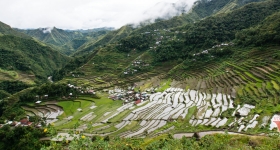
 Rice yields al‐
most doubled from 13 kilograms per hectare (kg/h) to 24 kg/h over this period. in 1903, irrigation, formal credit, and the growth in cultivated land.
Puzzlingly, titling variables appear to have very little to do with the increase in rice
production.
Rice yields al‐
most doubled from 13 kilograms per hectare (kg/h) to 24 kg/h over this period. in 1903, irrigation, formal credit, and the growth in cultivated land.
Puzzlingly, titling variables appear to have very little to do with the increase in rice
production.
under the United States Philippine exports
increased to abnormal levels. Buoyed by record exports ---which led to growth in the domestic
economy and consequently, public revenues (from internal sources and customs)--- the
Philippine national government led by American Governor General Francis Burton Harrison
(1913-1920) and in cooperation with top Filipino leaders undertook an economic development
program that was anchored on massive public investment. Conversely, the economy and by
extension, public revenues, floundered after the end of World War I in November 1918 as
exports to the United States spiraled downwards due to post-war American policy of “economic
normalcy”
Harrison’s replacement from the rival Republican Party, former US Army chief Major
General Leonard Wood, in 1921 had as his administrative priority the undoing of Harrison’s
economic development program beginning with the sale of public corporations either acquired or
created during Harrison’s administration. Wood’s “reform” agenda was a result of his personal
neo-liberal ideals and his political party’s conservative administrative agenda in the Philippines.
The reversal in policy was vehemently opposed by influential Filipino leaders in government for
political and economic reasons. Politically, the Filipino politicians hinged part of their campaign
for Philippine independence on the success of the said economic development program in
compliance with the American-imposed “stable government” requirement for self-rule. These
leaders also believed that the adverse economic conditions prevailing in 1921 was just
temporary, and that recovery was inevitable; thus, there was no need to abandon the economic
development agenda forged during Harrison’s administration.
The colossal conflict between Governor Wood and Filipino leaders reached its climax in
1923 when all the Filipino members of Wood’s cabinet resigned their positions in protest of the
chief executive’s perceived obstinacy. In the end, Wood viewed his role as Governor General not
as caretaker of a Philippine state that would eventually be independent in the foreseeable future
(as Harrison had), rather as an administrator whose main function was to provide stable
leadership during the country’s recovery from a crisis situation through his stewardship of a
conservative, neo-liberal economic agenda. The Filipino leaders were critical of Wood for failing
to grasp what they thought was the true nature of the governorship: a temporary custodian who
should not get in the way of Philippine independence, including its foundational economic
development agenda the infallibility of which was only temporarily side-tracked, and not truly
discredited
Ninety percent of total Philippine exports in 1917 came from four products: abaca or
Manila hemp (49 percent of the total); coconut oil (21 percent); sugar (13 percent) and tobacco
(7 percent). Manila hemp was, on average, sold about 80 pesos higher per 1,000 kilos in the
United States market in 1917 (Annual Report of the Governor General of the Philippine Islands,
On Aug 11, 1901, Company C, 9th US Infantry Regiment, arrived in Balangiga on the southern coast of Samar island, to close its port and prevent supplies reaching Filipino guerillas in the interior
 Us troops patrol on the coast of samar
A glamour unit, Company C was assigned provost duty and guarded the captured President Emilio Aguinaldo upon their return to the Philippines on June 5, 1901, after fighting Boxer rebels and helping capture Peking in China.
 "The first month of Company C’s presence in Balangiga was marked by extensive fraternization between the Americans and the local residents. The friendly activities included tuba (native wine) drinking among the soldiers and native males, baseball games and arnis (stick fighting) demonstrations in the town plaza, and even a romantic link between an American sergeant, Frank Betron, and a native woman church leader, Casiana “Geronima” Nacionales
 "Tensions rose when on September 22, at a tuba store, two drunken American soldiers tried to molest the girl tending the store. The girl was rescued by her two brothers, who mauled the soldiers. In retaliation, the Company Commander, Capt. Thomas W. Connell, West Point class of 1894, rounded up 143 male residents for forced labor to clean up the town in preparation for an official visit by his superior officers. They were detained overnight without food under two conical Sibley tents in the town plaza, each of which could only accommodate 16 persons; 78 of the detainees remained the next morning, after 65 others were released due to age and physical infirmity. Finally, Connell ordered the confiscation from their houses of all sharp bolos, and the confiscation and destruction of stored rice. Feeling aggrieved, the townspeople plotted to attack the U.S. Army garrison.
 Valeriano Abanador, the mastermind


The mastermind was Valeriano Abanador (LEFT, IN OLD AGE), a Letran dropout and the local chief of police; he was assisted by five locals and two guerilla officers under the command of Brig. Gen. Vicente Lukban: Capt. Eugenio Daza and Sgt. Pedro Duran, Sr. The lone woman plotter was Casiana “Geronima”
 Nacionales. Lukban played no role in the planning of the attack; he only learned about it a week later. About 500 men in seven attack units would take part. They represented virtually all families of Balangiga, whose outlying villages then included the present towns of Lawaan and Giporlos, and of Quinapundan, a town served by the priest in Balangiga.
"At 6:45 a.m., on Saturday, September 28, Abanador grabbed Pvt. Adolph Gamlin's rifle from behind and hit him unconscious with its butt. Abanador turned the rifle at the men in the sergeant’s mess tent, wounding one. He then waved a rattan cane above his head, and yelled: “Atake, mga Balangigan-on! (Attack, men of Balangiga!). A bell in the church tower was rung seconds later, to announce that the attack had begun.
 US COMPANY C IN BALANGIGA
"The guards outside the convent and municipal hall were killed. The Filipinos apparently sealed in the Sibley tents at the front of the municipal hall, having had weapons smuggled to them in water carriers, broke free and entered the municipal hall and made their way to the second floor. The men in the church broke into the convent through a connecting corridor and killed the officers who were billeted there. The mess tent and the two barracks were attacked. Most of the Americans were hacked to death before they could grab their firearms. The few who escaped the main attack fought with kitchen utensils, steak knives, and chairs.
"The convent was successfully occupied and so, initially, was the municipal hall, but the mess tent and barracks attack suffered a fatal flaw - about one hundred men were split into three groups, one of each target but too few attackers had been assigned to ensure success. A number of Co. C. personnel escaped from the mess tent and the barracks and were able to retake the municipal hall, arm themselves and fight back. Adolph Gamlin recovered consciousness, found a rifle and caused considerable casualties among the Filipinos. [Gamlin died at age 92 in the U.S. in 1969].
"Faced with immensely superior firepower and a rapidly degrading attack, Abanador ordered a retreat. But with insufficient numbers and fear that the rebels would re-group and attack again, the surviving Americans, led by Sgt. Frank Betron, escaped by baroto(native canoes with outriggers, navigated by using wooden paddles) to Basey, Samar, about 20 miles away. The townspeople returned to bury their dead, then abandoned the town."
Of the original 74 man contingent, 48 died and 26 survived, 22 of them severely wounded. The dead included all of Company C's commissioned officers: Capt. Thomas W. Connell (RIGHT), 1st Lt. Edward A. Bumpus, and Maj. Richard S. Griswold (the Company surgeon). The guerillas also took 100 rifles with 25,000 rounds of ammunition; 28 Filipinos died and 22 were wounded
On September 27, Friday, the natives sought divine help and intervention for the success of their plot through an afternoon procession and marathon evening novena prayers to their protector saints inside the church. They also ensured the safety of the women and children by having them leave the town after midnight, hours before the attack. Pvt. Adolph Gamlin observed women and children evacuating the town and reported it, but he was ignored.
KATIPUNAN AND THE ROUGH RIDERS CLASH
 Facing the prospect of defeat to a Great Power or to an upstart Filipino military, the Spanish
proposed surrender terms to the United States that involved a mock battle for Manila, and
the exclusion of Filipino insurgents. A staged battle would cause harm to few soldiers while
enabling the Spanish to maintain a higher sense of national honor. After agreeing with the
Americans to such conditions, the Spaniards raised the white flag to the U.S. “conquerors.”
Facing the prospect of defeat to a Great Power or to an upstart Filipino military, the Spanish
proposed surrender terms to the United States that involved a mock battle for Manila, and
the exclusion of Filipino insurgents. A staged battle would cause harm to few soldiers while
enabling the Spanish to maintain a higher sense of national honor. After agreeing with the
Americans to such conditions, the Spaniards raised the white flag to the U.S. “conquerors.”
 American military units obliged by charging the city as the Filipinos watched helplessly. On August 14 in the church of San Augustine, the Spanish formally yielded control of Manila to
the Americans.
American military units obliged by charging the city as the Filipinos watched helplessly. On August 14 in the church of San Augustine, the Spanish formally yielded control of Manila to
the Americans.
 ========


Blocked from entering the city, Aguinaldo and his followers rendezvoused in
a monastery north of Manila to establish a sovereign government, independent of the United
States. It was there that Aguinaldo wrote, “The people struggle for their independence, absolutely
convinced that the time has come when they can and should govern themselves.”
 THE UNITED STATES MANIFEST OF DESTINY
America’s war
with Spain exploded within a larger
wave of European and Japanese global
expansion, sometimes called the
“new imperialism.” What became a
rush for territorial acquisition sprang
from many different motivations,
ranging from economic, missionary,
and moral imperatives to a policy of
pure “realpolitik”—a raw, competitive
drive for national power and prestige
THE UNITED STATES MANIFEST OF DESTINY
America’s war
with Spain exploded within a larger
wave of European and Japanese global
expansion, sometimes called the
“new imperialism.” What became a
rush for territorial acquisition sprang
from many different motivations,
ranging from economic, missionary,
and moral imperatives to a policy of
pure “realpolitik”—a raw, competitive
drive for national power and prestige
For the United States, this Great Power race for empire coincided with Spanish mismanagement
of colonial Cuba, an island only 90 miles from the U.S. shores
President William McKinley sent the battleship U.S.S. Maine into Havana Harbor,
ostensibly to protect U.S. citizens. In an atmosphere of heightened tension, the Maine
mysteriously blew up, and American newspapers fanned the angry reaction at home, accusing
Spain of treachery.
Domestic pressure, therefore, contributed to McKinley’s declaration of war
on Spain in April. American victory after only four months left the United States in control of
the former Spanish colonies of Cuba and Puerto Rico in the Caribbean and Guam and the
Philippines in the Pacific.
 1898 was a major turning point in Philippines history. From the time Ferdinand Magellan
landed on Cebu on 16 March 1521 and claimed the archipelago for Spain. In 1542 the islandchain
was named Islas Filipinas in honor of Prince Felipe (later Philip II) of Spain. The first
permanent Spanish settlement was a fort and church on Cebu in 1565
1898 was a major turning point in Philippines history. From the time Ferdinand Magellan
landed on Cebu on 16 March 1521 and claimed the archipelago for Spain. In 1542 the islandchain
was named Islas Filipinas in honor of Prince Felipe (later Philip II) of Spain. The first
permanent Spanish settlement was a fort and church on Cebu in 1565
While over a thousand islands were inhabited, the capital of Manila increasingly dominated
culture and commerce in the course of the next 350 years. Sugar, hemp, and tobacco left Manila
Harbor to the markets of China and beyond BUT Few islanders benefited from
the Spanish shipping trade. Filipino men built the ships and served as sailors, but the pay was
poor.
Finally, in the late 19th century, a new group of Filipino activists began to emerge following an
1872 incident. Filipino workers and troops at the Cavite arsenal mutinied against the Spanish
for better pay and work conditions. While the uprising was quickly squelched, three local priests
who sought equality with Spanish priests were arrested and then executed near Manila Bay.
They became the first modern martyrs in the Filipino movement for national independence.

 The Filipino Revolution, therefore, began in 1896 when, under
the flag of the Katipunan, or “Society of the Sons of the
People,” some 20,000 Filipinos staged an uprising against their
Spanish overlords.
Emilio Aguinaldo,
the son of a wealthy aristocrat, rose quickly to the top of the
revolutionary movement, and became president of the
Katipunan in the spring of 1897. “Filipino citizens!” he declared.
“Let us follow the example of European and American
nations. Let us march under the Flag of Liberty, Equality,
and Fraternity!” With 200,000 Spanish troops tied down in
Cuba, Madrid could ill afford a war in the Philippines.
The Filipino Revolution, therefore, began in 1896 when, under
the flag of the Katipunan, or “Society of the Sons of the
People,” some 20,000 Filipinos staged an uprising against their
Spanish overlords.
Emilio Aguinaldo,
the son of a wealthy aristocrat, rose quickly to the top of the
revolutionary movement, and became president of the
Katipunan in the spring of 1897. “Filipino citizens!” he declared.
“Let us follow the example of European and American
nations. Let us march under the Flag of Liberty, Equality,
and Fraternity!” With 200,000 Spanish troops tied down in
Cuba, Madrid could ill afford a war in the Philippines.
Filipino nationalists were ecstatic. Led by General Aguinaldo, and, following years of fighting
for independence, they hoped for the honor of liberating Manila and declaring the birth of
their sovereign nation. Meanwhile, Dewey—now promoted to rear admiral—waited in Manila
for the U.S. Army to arrive. Intent on securing support from Filipino fighters, he sent a ship to
Hong Kong to retrieve Aguinaldo. Dewey welcomed the revolutionary leader as a co-equal.
While Aguinaldo wrestled with the fate of the movement he led, United States-Spanish peace
talks began in Paris on October 1, 1898. No Filipinos or Cubans attended the deliberations, nor
were any invited. McKinley clearly wanted Cuba from the Spanish, but he was not yet sure about
the Philippines. Ultimately, he decided that he needed the port of Manila in the Philippines in
order to have a naval base in the Western Pacific. After considerable debate and reflection, McKinley
also recommended annexing the Philippines rather than giving the Filipinos outright independence.
Undeterred by American actions in Paris and the White House, as well as the upcoming
treaty debate in the United States Senate, the Filipinos approved a constitution in January 1899
based on the republican representative principles embodied in the United States Constitution.
The 1898 election kept the Republicans in control of Congress. Five days later, President
McKinley’s cabled his terms to U.S. treaty negotiators in Paris. Secretary of State John Hay
then sent a follow up wire to the representatives: “Insist upon the cession of the whole of the
Philippines. If necessary, pay to Spain twenty million dollars.” Spain accepted the amended
terms and relinquished the Philippines, Cuba, Guam, and Puerto Rico. The 400-year-old, global
Spanish Empire had now vanished. But had the United States also become the “New Spanish
Empire” with the transfer of territories
And finally The United States had officially acquired its first colony - the Philippines
=================================
 McKinley’s decision and the Senate’s action, the U.S. Army battled Filipino
nationalist insurgents for four years, from 1898 to 1902.
McKinley’s decision and the Senate’s action, the U.S. Army battled Filipino
nationalist insurgents for four years, from 1898 to 1902.
In early 1899, as Rear Admiral Dewey doubled his order of ammunition
to deal with the Filipino insurrection
=============================
THE FILIPINO AMERICAN WAR
 “About eight o’clock, Miller
and I were cautiously pacing
our district. We came to a
fence and were trying to see
what the Filipinos were up to.
Suddenly, near at hand, on our
left, was a low but unmistakable
Filipino outpost signal
whistle. It was immediately
answered by a similar whistle
about twenty-five yards to the
right. Then a red lantern
flashed a signal from blockhouse
number seven. We have
never seen such a sign used
before. In a moment, something
rose up slowly in front of us. It was a Filipino. I yelled, “Halt!”
and made it pretty loud, for I was accustomed
to challenging the officer of the
guard in approved military style. I challenged
him with another loud “Halt!”
Then he shouted “Halto!” to me. Well, I
thought the best thing to do was to shoot
him. He dropped. If I didn’t kill him, I
guess he died of fright. Two Filipinos
sprang out of the gateway about fifteen
feet from us. I called, “Halt!” and Miller
fired and dropped one. I saw that another
was left. Well, I think I got my second
Filipino that time.”
“About eight o’clock, Miller
and I were cautiously pacing
our district. We came to a
fence and were trying to see
what the Filipinos were up to.
Suddenly, near at hand, on our
left, was a low but unmistakable
Filipino outpost signal
whistle. It was immediately
answered by a similar whistle
about twenty-five yards to the
right. Then a red lantern
flashed a signal from blockhouse
number seven. We have
never seen such a sign used
before. In a moment, something
rose up slowly in front of us. It was a Filipino. I yelled, “Halt!”
and made it pretty loud, for I was accustomed
to challenging the officer of the
guard in approved military style. I challenged
him with another loud “Halt!”
Then he shouted “Halto!” to me. Well, I
thought the best thing to do was to shoot
him. He dropped. If I didn’t kill him, I
guess he died of fright. Two Filipinos
sprang out of the gateway about fifteen
feet from us. I called, “Halt!” and Miller
fired and dropped one. I saw that another
was left. Well, I think I got my second
Filipino that time.”


Battle of Zapote River
The battle started around 6:15am after three shots were fired by the Filipinos to the American outpost from a 1-pounder Hotchkiss gun. In retaliation, the Sixth artillery under Lieutenant Benjamin M. Koehler fired back six shrapnels from two 3.2-inch (81 mm) guns
FIRST PHILIPPINE COMMISSION
On February 4, Aguinaldo declared "That peace and friendly relations with the Americans be broken and that the latter be treated as enemies, within the limits prescribed by the laws of war. On June 2, 1899, the Malolos Congress enacted and ratified a declaration of war on the United States, which was publicly proclaimed on that same day by Pedro Paterno, President of the Assembly.

An attack on the United States forces was planned which should annihilate the little army in Manila, and delegations were appointed to secure the interference of foreign powers. The protecting cloak of pretense of friendliness to the United States was to be kept up until the last. While commissioners were appointed to negotiate with General Otis, secret societies were organized in Manila pledged to obey orders of the most barbarous character to kill and burn. The attack from without and the attack from within was to be on a set day and hour. The strained situation could not last. The spark was applied, either inadvertently or by design, on the 4th of February by an insurgent, willfully transgressing upon what, by their own admission, was within the agreed limits of the holding of the American troops. Hostilities resulted and the war was an accomplished fact
 "On the night of February 2 they sent in a strong detachment to draw the fire of our outposts, which took up a position immediately in front and within a few yards of the same. The outpost was strengthened by a few of our men, who silently bore their taunts and abuse the entire night. This was reported to me by General MacArthur, whom I directed to communicate with the officer in command of the insurgent troops concerned. His prepared letter was shown me and approved, and the reply received was all that could be desired. However, the agreement was ignored by the insurgents and on the evening of February 4 another demonstration was made on one of our small outposts, which occupied a retired position at least 150 yards within the line which had been mutually agreed upon, an insurgent approaching the picket and refusing to halt or answer when challenged. The result was that our picket discharged his piece, when the insurgent troops near Santa Mesa opened a spirited fire on our troops there stationed.

The insurgents had thus succeeded in drawing the fire of a small outpost, which they had evidently labored with all their ingenuity to accomplish, in order to justify in some way their premeditated attack. It is not believed that the chief insurgent leaders wished to open hostilities at this time, as they were not completely prepared to assume the initiative. They desired two or three days more to perfect their arrangements, but the zeal of their army brought on the crisis which anticipated their premeditated action. They could not have delayed long, however, for it was their object to force an issue before American troops, then en route, could arrive in Manila."
By January 10, insurgents were ready to assume the offensive, but desired, if possible, to provoke the Americans into firing the first shot. They made no secret of their desire for conflict, but increased their hostile demonstrations and pushed their lines forward into forbidden territory. Their attitude is well illustrated by the following extract from a telegram sent by Colonel Cailles to Aguinaldo on January 10, 1899
BATTLE OF MANILA FEB 5, 1899
 us troops positioned against katipuneros


 1st colorado company of the US Army reinforcement
 1st colorado Us troops occupied Malate against Katipuneros


 minesota company of the US troops
================================
By late summer 1899, when stepped-up American troop reinforcements faced Aguinaldo’s equally
serious pledge to wage guerrilla-style war, the price tag for empire-building shot up. Casualty
figures in the Philippines also worried President McKinley. Three thousand Americans and
15,000 Filipinos had been killed
minesota company of the US troops
================================
By late summer 1899, when stepped-up American troop reinforcements faced Aguinaldo’s equally
serious pledge to wage guerrilla-style war, the price tag for empire-building shot up. Casualty
figures in the Philippines also worried President McKinley. Three thousand Americans and
15,000 Filipinos had been killed
South of Manila, in the province of Batangas, the Americans assembled all non-insurgents into
military zones of protection. The similarities to Spanish methods in Cuba were unmistakable,
as anyone found outside of these zones was assumed to be hostile, and were killed or imprisoned.
In April 1902, following more than three years of warfare, Filipino leaders conceded defeat to
the United States. For their part, the exhausted Americans had lost most of the zeal that had
led to late nineteenth-century imperialism. Even President Roosevelt, once a champion of U.S.
empire-building, admitted that his nation was ill-suited for imperialism. On reflection, he opined
that the Philippines had become America’s Achilles heel. While the United States would use
military force, time and again, across Latin America, and in portions of Asia, the Pacific, and
elsewhere,
