Linggo, Disyembre 11, 2016

CITY HEBRON ALLOWED BY THE HYKSOS


HYKSOS REIGN IN EGYPT


Salitis (Sheshi) hyksos king of egypt


Hebron was built seven years before Zoar in Egypt


Hyksos rule over Lower Egypt lasted from the conquest of Memphis by Salitis (Sheshi) in 1674, till their expulsion in 1567 BCE and was mainly a time of peace and prosperity. Major Hyksos cities or camps were Heliopolis, Avaris

Their conquests were strengthened by a type of rectangular fortification of beaten earth used as a fortress; archaeologists have uncovered examples of these mounds in Canaan at Jericho, Sihem, and Lahish.


Expulsion and pursuit of the Hyksos by Ahmose


 The Hyksos seem to have behaved in accordance with Egyptian manners, laws, and theories of monarchy since the times of Khyan (Iannas, last third of the 17th century). It was also during his reign that Hyksos influence, political and economical, over Egypt and Canaan became more marked. They maintained tribute or trade relations with the Minoans and Babylonians and Egyptian artifacts bearing Khyan's name were found as far as Babylon, Knossos and Hatti. As so often happened in the ancient world, the foreign conquerors gradually adopted the ways of the conquered.


But the Hyksos dream of being integrated into Egyptian society died within a century. The ruling family of Upper Egypt which originated from Thebes, waged war against the Hyksos kings. Apepi I

to counter the threat posed by Tao II (Sekenenre) and Kamose (Wadjkheperre) by entering into an alliance with the Kushites who had conquered Nubia. He killed Tao II in battle (though some think that Tao was assassinated), but had to retreat northward before Kamose to the vicinity of Avaris in the delta.


Amosis  PHARAOH OF EGYPT


WAR BETWEEN HYKSOS ANS THE ARMY OF AMOSIS 


Khamudi (Apepi II)

 In the end the Thebans forced Khamudi (Apepi II), the last king of the 15th (Hyksos) Dynasty to negotiate the withdrawal of the Hyksos army from Avaris and most of the Delta. The southern Pharaohs did not keep the agreement and Amosis (Ahmose I), the great general, drove the Hyksos out of Egypt by 1550 BCE after a decisive victory at Tanis.


ZOAR 
Zoara, the biblical Zoar, previously called Bela (Genesis 14:8), was one of the five "cities of the plain- a pentapolis apparently located along the lower Jordan Valley and the Dead Sea plain and mentioned in the Book of Genesis. It was spared the "brimstone and fire" which destroyed Sodom and Gomorrah in order to provide a refuge for Lot and his daughters.[

zOARA small city near Egypt  near sodom and gomorrah


THE HEBREWS IN EGYPT


                                                                the hebrew slavery


Map of the Realm of the Hyksos


Egypt certainly was a more powerful monarchy than any existing on the earth in the time of Abraham.

 It was probably inhabited by a mixed race, hebrews and the people of Ham  as well as Hamite; though the latter had the supremacy. The distinction of castes indicates a mixed population, so that the ancients doubted whether Egypt belonged to Asia or Africa. The people were not black, but of a reddish color, with thick lips, straight black hair, and elongated eye, and sunk in the degraded superstitions of the African race

The river Nile,  runs 3,000 miles nearly due north to the Mediterranean. Its annual floodingprovided water of the wheat farming in  the valley of Avaris  with a rich soil brought down from the mountains of Abyssinia, making it the most fertile in the world. The country, thus so favored by a great river, with its rich alluvial deposits, is about 500 miles in length, with an area of 115,000 square miles, of which 9,600 are subject to the fertilizing inundation. But, in ancient times, a great part of the country was irrigated, and abounded in orchards, gardens, and vineyards. Every kind of vegetable was cultivated, and grain was raised in the greatest abundance, so that the people lived in luxury and plenty while other nations were subject to occasional famines.


THE HEBREW SLAVERY

The story begins some 3500 years ago in the land of Egypt. A man named Jacob brought his family to live in Egypt for two reasons. One, there was a bad shortage of food in Jacob's own land of Canaan. Two, Jacob's favorite son Joseph happened to be ruling Egypt for the Pharaoh at the time. Those Hebrew people lived in Egypt for 400 years.


THE HYKSOS KINGS IN EGYPT

Dynasties XII to XVII
The growth of the middle class and the conquest of the Hyksos

The 12th dynasty which was founded by Amenemhet I, Mentuhotep IV's vizier, (1991 BCE), and worked hard to restore royal prestigeencourage recruitment of able civil servants and their unconditional allegiance, and transform the royal image from that of an insecure war leader to that of a confident, semidivine ruler. They continued the tradition of pyramid building and were buried in the Fayum region and at Dahshur.

  The external situation remained dangerous. The northern Nubian and Sinai buffer zones were reoccupied and, for the first time, heavily


 Amenemhet I, (Ammenemes I) , murdered in 1962 BCE, overthrew the Theban rulers of Egypt to found the 12th Dynasty about 1991 BCE. He campaigned against the Libyans and the nomads in the Sinai.


For a while they ruled Egypt like at the beginning, but gradually the Egyptians Got tired of being ruled by foreigners. called HYKSOS  They got an army and took back rulership. After they took control of the land, they started to treat the family of Jacob very badly. The people were by this time known as Israelites and had grown much in population. By the time the 400 years were past, the Israelites became slaves to Egypt.


Sesostris


 Senusret I (Sesostris), (1971-1928 BCE) who had not been appointed successor yet, secured the throne for himself after Amenemhet's assassination, by executing the plotters and publicizing his father's testament,The Teachings of Amenemhet, which became an Egyptian literary classic. He conquered Lower Nubia (Wawat) and controlled it by building a number of fortresses, among them Buhen.

 military expeditions lso were directed toward internal affairs and the nomarchs. These nomarchs were nobles of Egyptian provinces, or nomes, and served as the kings representatives. Raising their own armies, they defended their own borders.


MOSES LED THE HEBREWS OUT FROM SLAVERY   1446 BC

The Israelites had to work long and hard at making building bricks for the Egyptians. At one point, the Pharaoh ruled that if a man didn't meet his quota of bricks for the day, that his baby was to be put into the buildings instead of bricks. This kind of persecution got worse. The king pharaoh was afraid of a prophecy that foretold of a deliverer for the Hebrew people. So the pharaoh ordered that all of the baby boys be thrown in the river from then on.

That deliverer was Moses. Moses was taken out of the river and raised by Pharaoh's daughter. Moses had grown up in Pharaoh's Court, but was not in Egypt the whole time up to the plagues. He had spent 59 years in other lands before he returned to Egypt to help the Israelites escape. Forty of those years Moses spent as a King in the land of Cush. He was at least 76 years old when he came back to Egypt


ten plagues that God sent upon the Egyptians. The last of these is the one we want to look at. With the other plagues, the Hebrews didn't have to worry. They were automatically protected from the hail, and lice, and the other stuff. They didn't have to do anything. But this time the people were asked to do some pretty strange things. Just on Moses' say-so. Moses sent messengers around with instructions for the people to follow. So it isn't like God came and told each person what was going to happen. I bet many of them didn't know any more than that they would escape some terrible thing if they acted in faith on Moses' word.

IN 1446 BC.... THE EXODUS....
there were over 2,000,000 people there in the land of Goshen, Egypt. . And they all had to faithe at the same time. Talk about faith moving mountains. What happened when the Hebrews faithed was more terrible and miraculous. 

That was unusual enough, but there was more. They were told not to get ready for bed, but to strap on their shoes, ware their cloaks, get a staff and hold it, and eat like they were in a hurry to take a trip -- probably standing up. Seems silly to eat a roasted lamb standing up, doesn't it? God has a way of testing our trust in Him by asking us to do things that don't look like they'll help. I mean, who would know if some of the people inside the houses were eating the lamb in a hurry or taking their time to enjoy the flavor


God sent an angel to kill all the first born of each family; even the families of animals. Everywhere in Egypt people died; even statues of the first born were destroyed. Except over in Goshen where the people had put blood on the door.


 Angel of Death came over the land of Egypt that night, and killed all the first born, there were also some Israelites who lost a son or daughter, or a sheep or goat. Some people don't learn even after nine plagues go by. They think in their hearts that they're not brave enough to take the risks that go with faithing.  Hebrew man saying that he couldn't afford to kill his lamb. That doesn't show much trust in God.


Sabado, Disyembre 10, 2016

THERE WAS A TIME WHEN THE WORLD WAS UNDER EGYPT


The Battle of Kadesh
         c.1273 BCE


The decisive war between the Egyptians and the Hittites for the control over Syria took place in the spring of the fifth year of the reign of Ramses II. The battle of Kadesh resulted from the defection of Amurru to Egypt. While the Hittites wanted to bring Amurru back into their fold, the Egyptians tried to protect their new vassal. Using Karkemish as a base for their operations, the Hittites decided Kadesh offered the best opportunities for the coming battle. Muwatalli had called on his allies, among them Rimisharrinaa, king of Aleppo
    ... the Sun, the Great King of Hatti, son of Mursili, and all the House of Suppiluliuma, will be allies of the king of Aleppo. The gods of Hatti and the gods of Aleppo will be witnesses and guarantors of this treaty

  The country of Kizwadna
    which had belonged to Hatti in the times of Suppiluliuma and had been aquired by the Hurri, belongs again to Muwatalli. Its king will send one hundred horses equipped [with chariots] and a thousand footsoldiers to the army of the Sun, who will provide for them.


Similar treaties had been concluded with most of Hatti's neighbours, resulting in a hotchpotch, not the most reliable kind of army a king could lead into battle.
    The army of Ramses on the other hand consisted probably mostly of Egyptians, with a few Nubian contingents and some Sherden mercenaries. The chariots were manned exclusively by Egyptian noblemen. The records do not mention how many Egyptian soldiers there were. It is generally assumed that an Egyptian division was comprised of 5000 footsoldiers. Ramses setting out with four divisions of 20,000 seems reasonable but remains speculative.


  The Hittite army of 37,000 footsoldiers and 3500 chariots was hiding behind the tell of Kadesh, but Ramses believed false rumors that his enemy was still near Haleb. After beating what he thought was the truth out of two captured Hittites, he held a council of war and the vizier in a chariot and a rider on horseback were dispatched south to hasten the progress of the Ptah division.
    While the Amen division was setting up camp, 2500 Hittite chariots attacked the marching Re division in two waves. The other two Egyptian divisions were still on the far side of the river Orontes (Arnath) near the town of Sabtuna. 


the possibility of the Hittite army being able to hide from the view of the Egyptians and ford the Orontes in sufficient numbers in a very short time to be able to mount a surprise attack.   but if they were stationed on the western bank of the river they did not have to cross the Orontes itself but only the small brook el Mukadiyeh, being stationed on the fields between the river and the town.

The Hittites dispersed the Amen division and began pillaging the Egyptian camp. The Pharaoh, fighting among his body guard with his back to the river, looked lost.

At this time, a force referred to asnearin arrived, surprising the pilfering Hittites, and drove them out of the camp. Their identity is the subject of debate. At times they are equated with sDm-aS(Sedjemash), which accords well with the meaning of Ugaritic n'rm. According to this interpretation they were camp-followers: servants, grooms and others. Others see them as recruits coming from Amurru.
    Muwatalli sent an additional 1000 chariots led by the kings of Aleppo and Karkhemish, two of his own brothers and many allied princes, but kept most of his infantry to himself on the far side of the river.


Ramses reorganized his forces and the Hittites escaped being surrounded by the Egyptians by retreating towards Kadesh.
    After receiving a message from Muwatalli, Ramses decided to retreat. According to the Egyptians, the "wretched, vanquished chief of Hatti" pleaded with the pharaoh

    Suteh are you, Baal himself, your anger burns like fire in the land of Hatti... Your servant speaks to you and announces that you are the son of Re. He put all the lands into your hand, united as one. The land of Kemi, the land of Hatti, are at your service. They are under your feet. Re, your exalted father, gave them to you so you would rule us. Is it good, that you should kill your servants? ... Look at what you have done yesterday. You have slaughtered thousands of your servants ... You will not leave any inheritance. Do not rob yourself of your property, powerful king, glorious in battle, give us breath in our nostrils.

  The route through the Biqa'a valley being considered too risky, it was decided to take the route east of it, through Upe in the region of Damascus.
    The battle of Kadesh should perhaps not be called a battle in the strictest sense of the word, but rather a large-scale skirmish preceding the decisive encounter which in the end never took place. Nevertheless, Muwatalli was able to rob his opponent of the initiative and eliminated about a third of his troops.
    The failure of Ramses' campaign was a result of his tactical mistakes. He did not send enough scouts to explore the countryside sufficiently, the divisions were separated by up to 15 kms from each other and there was no adequate protection of the flanks. Still, the king blamed his troops

    not one of my princes, of my chief men and my great,
Was with me, not a captain, not a knight;
For my warriors and chariots had left me to my fate,
Not one was there to take his part in fight.
........
Here I stand,
All alone;
There is no one at my side,
My warriors and chariots afeared,
Have deserted me, none heard
My voice, when to the cravens I, their king, for succor, cried.
But I find that Ammon's grace
Is better far to me
Than a million fighting men and ten thousand chariots be.
 This attack on the army and his leaders was the beginning of the gradual distancing process between army and king,  Ramses described the campaign as a splendid victory, while in reality Kadesh remained in Hittite hands, Amurru fell to the Hittites and the Egyptian losses were substantial.


 Apart from the scenes in which Qadesh itself is represented with some bridges over its encircling moats, it is clear that,  Orontes was at its lowest point,  Hence, certain practical limits can be set on the Hittite surprise attack on Ra-division in march. It is impossible to assume that the Hittite charioteers, who attacked and crashed through the midst of Ra, were only the " first battle line" of the group itself. Breaking a compact force of 5000 men in march - like an Egyptian division - needs a prolonged attack of a massive chariot-force. In this circumstance it is right to assume that a chariot-force marshalled to fight in a open plain, like those of Qadesh, would have been visible at the advancing column of the Ra-division. Similarly, the advancing of Hittite forces (chariots and infantry) from their encampment to cross the Orontes, in correspondence with the line of march of Ra, would have been visible from the Egyptian camp.


AFTER THE BATTLE.. AIGYPTOS CALLED EGYPT HAD THE CONTROLS OVER PALESTINE
\\\\\\\\\\\\\\\\\\\\\\\\\\\\\\\\\\\\\\\\\\\\\\\\\\\\\\\\\\\\\\\\\\\\\\\\\\\\\\\

the story of dardanus


Dardanus, , is the primitive ancestor of the Trojan kings, whose seat of power was Mount Ida. His son, Erichthonius, became the richest of mankind, and had in his pastures three thousand mares. His son, Tros, was the father of Ilus, Assarcus, and Ganymede.

 Ilus was the father of Laomedon, under whom Apollo and Poseidon, in mortal form, went through a temporary servitude—the former tending his flocks, the latter building the walls of Ilium. Laomedon was killed by Hercules, in punishment for his perfidy in giving him mortal horses for his destruction of a sea monster, instead of the immortal [pg 169] horses, as he had promised, the gift of Zeus to Tros

 Among the sons of Laomedon was Priam, who was placed upon the throne. He was the father of illustrious sons, among whom were Hector and Paris. The latter was exposed on Mount Ida, to avoid the fulfillment of an evil prophecy, but grew up beautiful and active among the flocks and herds. It was to him that the three goddesses, Here, Athenæ, and Aphrodite (Juno, Minerva, and Venus), presented their respective claims to beauty, which he awarded to Aphrodite, and by whom he was promised, in recompense, Helen, wife of the Spartan king, Menelaus, and daughter of Zeus. Aphrodite caused ships to be built for him, and he safely arrived in Sparta, and was hospitably entertained by the unsuspecting monarch. In the absence of Menelaus in Crete, Paris carries away to Troy both Helen, and a large sum of money belonging to the king. Menelaus hastens home, informed of the perfidy, and consults his brother, Agamemnon, and the venerable Nestor. They interest the Argeian chieftains, who resolve to recover Helen. Ten years are spent in preparations, consisting of one thousand one hundred and eighty-six ships, and one hundred thousand men, comprised of heroes from all parts of Greece, among whom are Ajax, Diomedes, Achilles, and Odysseus. The heroes set sail from Aulis, and after various mistakes, reach Asia. 

 Meanwhile the Trojans assemble, with a large body of allies, to resist the invaders, who demand the redress of a great wrong. The Trojans are routed in battle, and return within their walls. After various fortunes, the city is taken, at the end of ten years, by stratagem, and the Grecian chieftains who were not killed seek to return to their own country, with Helen among the spoils. They meet with many misfortunes, from the anger of the gods, for not having spared the altars of Troy. Their chieftains quarrel among themselves, and even Agamemnon and Menelaus lose their fraternal friendship. After long wanderings, and [pg 170] bitter disappointments, and protracted hopes, the heroes return to their homes—such as war had spared—to recount their adventures and sufferings, and reconstruct their shattered States, and mend their broken fortunes—a type of war in all the ages, calamitous even to conquerors. The wanderings of Ulysses have a peculiar fascination, since they form the subject of the Odyssey, one of the noblest poems of antiquity. Nor are the adventures of Æneas scarcely less interesting, as presented by Virgil, who traces the first Settlement of Latium to the Trojan exiles. We should like to dwell on the siege of Troy, and its great results, but the subject is too extensive and complicated. The student of the great event, whether historical or mystical, must read the detailed accounts in the immortal epics of Homer. We have only space for the grand outlines, which can be scarcely more than allusions. 

 the descendants of Perseus, who was a descendant of Danaus, reigned at Mycenæ in Argolis—among whom was Amphitryon, who fled to Thebes, on the murder of his uncle, with Alemena his wife. Then Hercules, to whom the throne of Mycenæ legitimately belonged, was born, but deprived of his inheritance by Eurystheus—a younger branch of the Perseids—in consequence of the anger and jealousy of Juno, and to whom, by the fates, Hercules was made subject. We have seen how the sons of Hercules, [pg 171] under Hyllos, attempted to regain their kingdom, but were defeated, and retreated among the Dorians. 

 After three generations, the Heraclidæ set out to regain their inheritance, assisted by the Dorians. They at length, after five expeditions, gained possession of the country, and divided it, among the various chieftains, who established their dominion in Argos, Mycenæ, and Sparta, which, at the time of the Trojan war, was ruled by Agamemnon and Menelaus, descendants of Pelops. In the next generation, Corinth was conquered by the Dorians, under an Heraclide prince. 

 The Achæans, thus expelled by the Dorians from the south and east of the Peloponnesus, fell back upon the northwest coast, and drove away the Ionians, and formed a confederacy of twelve cities, which in later times became of considerable importance. The dispossessed Ionians joined their brethren of the same race in Attica, but the rugged peninsula was unequal to support the increased population, and a great migration took place to the Cyclades and the coasts of Lydia. The colonists there built twelve cities, about one hundred and forty years after the Trojan war. Another body of Achæans, driven out of the Peloponnesus by the Dorians, first settled in BÅ“otia, and afterward, with Æolians, sailed to the isle of Lesbos, where they founded six cities, and then to the opposite mainland.

 Crete was founded by a body of Dorians and conquered Achæans. Rhodes received a similar colony. So did the island of Cos. The cities of Lindus, Ialysus, Camirus, Cos, with Cnidus and Halicarnassus, on the mainland, formed the Dorian Hexapolis of Caria, inferior, however, to the Ionian and Æolian colonies.

 Hellenic races were the Achæans and Æolians; at the close, the Ionians and Dorians were predominant. The Ionians extended their maritime possessions [pg 172] from Attica to the Asiatic colonies across the Ægean, and gradually took the lead of the Asiatic Æolians, and formed a great maritime empire under the supremacy of Athens. The Hellenic world ultimately was divided and convulsed by the great contest for supremacy between the Dorians and Ionians, until the common danger from the Persian invasion united them together for a time. 

 The historical period begins with the First Olympiad, B.C. 776. Before this all is uncertain, yet as probable as the events of English history in the mythical period between the departure of the Romans and the establishment of the Anglo-Saxon kingdom. The history is not all myth; neither is it clearly authenticated.


 The various Hellenic tribes, though separated by political ambition, were yet kindred in language and institutions. They formed great leagues, or associations, of neighboring cities, for the performance of religious rites. The Amphictyonic Council, which became subsequently so famous, was made up of Thessalians, BÅ“otians, Dorians, Ionians, Achæans, Locrians, and Phocians—all Hellenic in race. Their great centre was the temple of Apollo at Delphi. The different tribes or nations also came together regularly to take part in the four great religious festivals or games—the Olympic, Pythian, Isthmian, and Nemæan—the two former of which were celebrated every four years. 

 There was a rude civilization among the ancient Greeks, reminding us of the Teutonic tribes, but it was higher than theirs. We observe the division of the people into various trades and occupations—carpenters, smiths, leather-dressers, leeches, prophets, bards, and fishermen, although the main business was agriculture. Cattle were the great staple of wealth, and the largest part of the land was devoted to pasture. The land was tilled chiefly by slaves, and women of the servile class were doomed to severe labor and privations. They brought the water, and they turned the mills. Spinning and weaving were, however, the occupations of all, and garments for men and women were alike made at home. There was only a limited commerce, which was then monopolized by the PhÅ“nicians, who exaggerated the dangers of the sea. There were walled cities, palaces, and temples. Armor was curiously wrought, and arms were well made. Rich garments were worn by princes, and their palaces glittered with the precious metals. Copper was hardened so as to be employed in weapons of war. The warriors had chariots and horses, and were armed with sword, dagger, and spear, and were protected by helmets, breastplates, and greaves. Fortified cities were built on rocky elevations, although the people generally lived in unfortified villages. The means of defense were superior to those of offense, which enabled men to preserve their acquisitions, for the ancient chieftains resembled the feudal barons [pg 176] of the Middle Ages in the passion for robbery and adventure. We do not read of coined money nor the art of writing, nor sculpture, nor ornamental architecture among the Homeric Greeks; but they were fond of music and poetry. Before history commences, they had their epics, which, sung by the bards and minstrels, furnished Homer and Hesiod with materials for their noble productions. It is supposed by Grote that the Homeric poems were composed eight hundred and fifty years before Christ, and preserved two hundred years without the aid of writing—of all poems the most popular and natural, and addressed to unlettered minds. 

 Sparta was in a state of anarchy in consequence of the Dorian conquest, a contest between the kings, aiming at absolute power, and the people, desirous of democratic liberty. At this juncture the king, Polydectes, died, leaving Lycurgus, his brother, guardian of the realm, and of the infant heir to the throne. The future lawgiver then set out on his travels, visiting the other States of Greece, Asia Minor, Egypt, and other countries, and returned to Sparta about the period of the first Olympiad, B.C. 776, with a rich store of wisdom and knowledge. The State was full of disorders, but he instituted great reforms, aided by the authority of the Delphic oracle, and a strong party of influential men. His great object was to convert the citizens of Sparta into warriors united by the strongest bonds, and trained to the severest discipline, governed by an oligarchy under the form of the ancient monarchy. In other words, his object was to secure the ascendency of the small body of Dorian invaders that had conquered Laconia. 

 The descendants of these invaders, the Spartans, alone possessed the citizenship, and were equal in political rights. [pg 178] They were the proprietors of the soil, which was tilled by Helots. The Spartans disdained any occupation but war and government. They lived within their city, which was a fortified camp, and ate in common at public tables, and on the simplest fare. Every virtue and energy were concentrated on self-discipline and sacrifice, in order to fan the fires of heroism and self-devotion. They were a sort of stoics—hard, severe, proud, despotic, and overbearing. They cared nothing for literature, or art, or philosophy. Even eloquence was disdained, and the only poetry or music they cultivated were religions hymns and heroic war songs. Commerce was forbidden by the constitution, and all the luxuries to which it leads. Only iron was allowed for money, and the precious metals were prohibited. Every exercise, every motive, every law, contributed to make the Spartans soldiers, and nothing but soldiers. Their discipline was the severest known to the ancients. Their habits of life were austere and rigid. They were trained to suffer any hardship without complaint. 

 Besides these Spartan citizens were the PeriÅ“ci—remnants of the old Achæan population, but mixed with an inferior class of Dorians. They had no political power, but possessed personal freedom. They were landed proprietors, and engaged in commerce and manufactures.

 All political power was in the hands of the citizen warriors, only about nine thousand in number in the time of Lycurgus. From them emanated all delegated authority, except that of kings. This assembly, or ecclesia, of Spartans over thirty years of age, met at stated intervals to decide on all important matters submitted to them, but they had no right of amendment—only a simple approval or rejection

 The body to which the people, it would seem, delegated considerable power, was the Senate, composed of thirty members, not under sixty years of age, and elected for life. They were a deliberative body, and judges in all capital charges against Spartans. They were not chosen for noble birth or property qualifications, but for merit and wisdom

The Battle of Carchemish.


 it took place in the 21st year of Nabopolassar before he died on Ab 8 (= Aug. 15, 605). Since the Babylonian year had begun April 12 in 605, and Nebuchadnezzar before the end of August
 had defeated the Egyptians not only at Carchemish, but also at Hamath and had "conquered the whole area of the gatticountry,"


////

in the days of Peleg


in the days of Peleg  when he was born the children of Noah began to divide the earth amongst themselves

Arpachshad took to himself a wife and her name was Rasu'eja, the daughter of Susan, the daughter of Elam, 

and she bare him a son 

and he called his name Kainam.


And the son grew, and his father taught him writing, and he went to seek for himself a place where he might seize for himself a city.


he took to himself a wife, and her name was Melka, the daughter of Madai, the son of Japheth,


he begat a son, and called his name Shelah; for he said: 'Truly I have been sent.'

Shelah grew up and took to himself a wife, and her name was Mu'ak, the daughter of Kesed, his father's brother


And she bare him a son   

 he called his name Eber: and he took unto himself a wife, and her name was 'AzĂ»rĂ¢d, the daughter of Nebrod

she bare him son, and he called his name Peleg; for in the days when he was born the children of Noah began to divide the earth amongst themselves: for this reason he called his name Peleg.


And it came to pass


that they divided the earth into three parts, for Shem and Ham and Japheth, according to the inheritance of each, in the first year in the first week, when one of us who had been sent, was with them.


And he called his sons, and they drew nigh to him, they and their children, and he divided the earth into the lots, which his three sons were to take in possession, and they reached forth their hands, and took the writing out of the bosom of Noah, their father.


And there came forth on the writing as Shem's lot the middle of the earth which he should take as an inheritance for himself and for his sons for the generations of eternity, from the middle of the mountain range of Rafa, from the mouth of the water from the river Tina, and his portion goes towards the west through the midst of this river, and it extends till it reaches the water of the abysses, out of which this river goes forth and pours its waters into the sea Me'at, and this river flows into the great sea. And all that is towards the north is Japheth's, and all that is towards the south belongs to Shem.


And it extends till it reaches Karaso: this is in the bosom of the tongue which looks towards the south.

And his portion extends along the great sea, and it extends in a straight line till it reaches the west of the tongue which looks towards the south: for this sea is named the tongue of the Egyptian Sea.

And it turns from here towards the south towards the mouth of the great sea on the shore of (its) waters, and it extends to the west to 'Afra, and it extends till it reaches the waters of the river Gihon, and to the south of the waters of Gihon, to the banks of this river.

And it extends towards the east, till it reaches the Garden of Eden, to the south thereof, [to the south] and from the east of the whole land of Eden and of the whole east, it turns to the east and proceeds till it reaches the east of the mountain named Rafa, and it descends to the bank of the mouth of the river Tina.

This portion came forth by lot for Shem and his sons, that they should possess it for ever unto his generations for evermore.


And Noah rejoiced that this portion came forth for Shem and for his sons, and he remembered all that he had spoken with his mouth in prophecy; for he had said: 'Blessed be the Lord God of Shem And may the Lord dwell in the dwelling of Shem.'

And he knew that the Garden of Eden is the holy of holies, and the dwelling of the Lord, and Mount Sinai the centre of the desert, and Mount Zion -the centre of the navel of the earth: these three were created as holy places facing each other.


And he blessed the God of gods, who had put the word of the Lord into his mouth, and the Lord for evermore.


And he knew that a blessed portion and a blessing had come to Shem and his sons unto the generations for ever -the whole land of Eden and the whole land of the Red Sea, and the whole land of the east and India, and on the Red Sea and the mountains thereof, and all the land of Bashan, and all the land of Lebanon and the islands of Kaftur, and all the mountains of Sanir and 'Amana, and the mountains of Asshur in the north, and all the land of Elam, Asshur, and Babel, and Susan and Ma'edai, and all the mountains of Ararat, and all the region beyond the sea, which is beyond the mountains of Asshur towards the north, a blessed and spacious land, and all that is in it is very good.


And for Ham came forth the second portion, beyond the Gihon towards the south to the right of the Garden, and it extends towards the south and it extends to all the mountains of fire, and it extends towards the west to the sea of 'Atel and it extends towards the west till it reaches the sea of Ma'uk -that (sea) into which everything which is not destroyed descends.


And it goes forth towards the north to the limits of Gadir, and it goes forth to the coast of the waters of the sea to the waters of the great sea till it draws near to the river Gihon, and goes along the river Gihon till it reaches the right of the Garden of Eden


And this is the land which came forth for Ham as the portion which he was to occupy for ever for himself and his sons unto their generations for ever.


And for Japheth came forth the third portion beyond the river Tina to the north of the outflow of its waters, and it extends north- easterly to the whole region of Gog, and to all the country east thereof.


And it extends northerly to the north, and it extends to the mountains of Qelt towards the north, and towards the sea of Ma'uk, and it goes forth to the east of Gadir as far as the region of the waters of the sea.

And it extends until it approaches the west of Fara and it returns towards 'Aferag, and it extends easterly to the waters of the sea of Me'at.


And it extends to the region of the river Tina in a north-easterly direction until it approaches the boundary of its waters towards the mountain Rafa, and it turns round towards the north.


This is the land which came forth for Japheth and his sons as the portion of his inheritance which he should possess for himself and his sons, for their generations for ever; five great islands, and a great land in the north.


But it is cold, and the land of Ham is hot, and the land of Shem is neither hot nor cold, but it is of blended cold and heat.


And Ham divided amongst his sons, and the first portion came forth for Cush towards the east, and to the west of him for Mizraim, and to the west of him for Put, and to the west of him [and to the west thereof] on the sea for Canaan.


And Shem also divided amongst his sons, and the first portion came forth for Elam and his sons, to the east of the river Tigris till it approachcs the east, the whole land of India, and on the Red Sea on its coast, and the waters of Dedan, and all the mountains of Mebri and Ela, and all the land of Susan and all that is on the side of Pharnak to the Red Sea and the river Tina.


And for Asshur came forth the second Portion, all the land of Asshur and Nineveh and Shinar and to the border of India, and it ascends and skirts the river.


And for Arpachshad came forth the third portion, all the land of the region of the Chaldees to the east of the Euphrates, bordering on the Red Sea, and all the waters of the desert close to the tongue of the sea which looks towards Egypt, all the land of Lebanon and Sanir and 'Amana to the border of the Euphrates.

And for Aram there came forth the fourth portion, all the land of Mesopotamia between the Tigris and the Euphrates to the north of the Chaldees to the border of the mountains of Asshur and the land of 'Arara.

And there came forth for Lud the fifth portion, the mountains of Asshur and all appertaining to them till it reaches the Great Sea, and till it reaches the east of Asshur his brother.


And Japheth also divided the land of his inheritance amongst his sons.

And the first portion came forth for Gomer to the east from the north side to the river Tina; and in the north there came forth for Magog all the inner portions of the north until it reaches to the sea of Me'at.


nd for Madai came forth as his portion that he should posses from the west of his two brothers to the islands, and to the coasts of the islands.

And for Javan came forth the fourth portion every island and the islands which are towards the border of Lud.

And for Tubal there came forth the fifth portion in the midst of the tongue which approaches towards the border of the portion of Lud to the second tongue, to the region beyond the second tongue unto the third tongue


And for Meshech came forth the sixth portion, all the region beyond the third tongue till it approaches the east of Gadir.


And for Tiras there came forth the seventh portion, four great islands in the midst of the sea, which reach to the portion of Ham [and the islands of Kamaturi came out by lot for the sons of Arpachshad as his inheritance


And thus the sons of Noah divided unto their sons in the presence of Noah their father, and he bound them all by an oath, imprecating a curse on every one that sought to seize the portion which had not fallen (to him) by his lot.


And they all said, 'So be it; so be it ' for themselves and their sons for ever throughout their generations till the day of judgment, on which the Lord God shall judge them with a sword and with fire for all the unclean wickedness of their errors, wherewith they have filled the earth with transgression and uncleanness and fornication and sin.


//


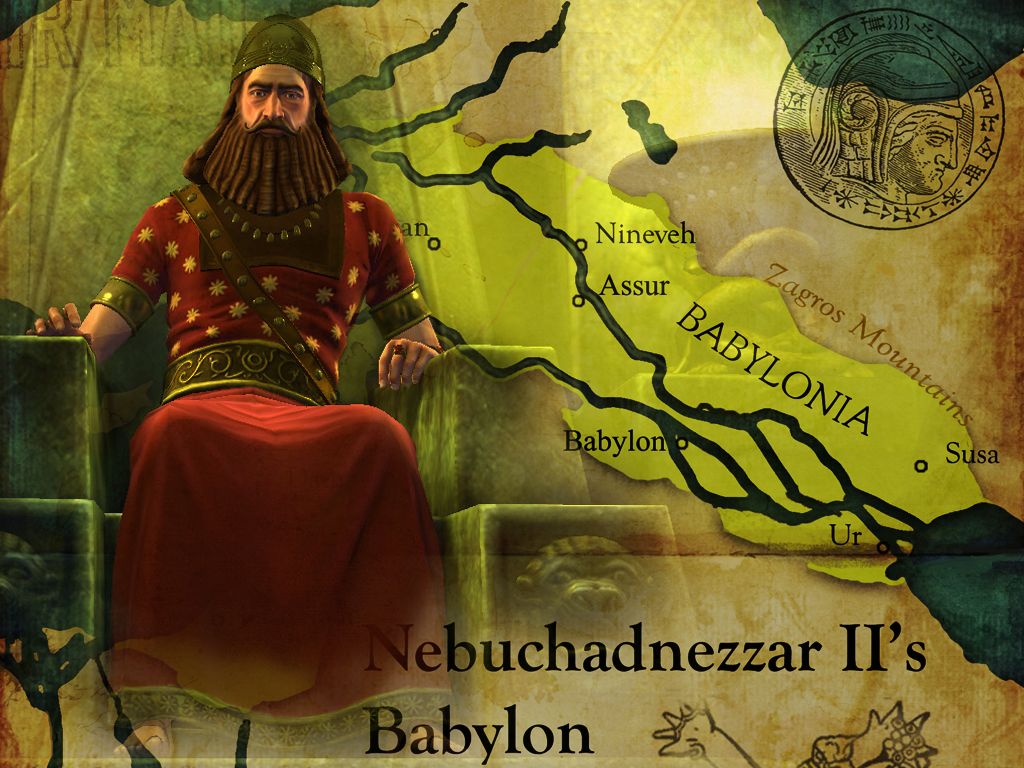
Nebuchadnezzar II KING OF BABYLON


Nabopolassar father of Nebuchadnezzar


Nebuchadnezzar II Viewing the Hanging Garden


                               SAMMURAUT, QUEEN OF BABYLON

Semiramis Receiving Word of the Revolt of Babylon


deportation of the Hebrews to Babylonia


Nabopolassar died at this moment. His son and successor Nebuchadnezzar II had been his father's Commander-in-Chief, and was a general of great experience and ability. He grasped the remains of the Assyrian Empire, and extended his authority to the Egyptian border, his two attacks upon Jerusalem (597 and 587 B.C.), and the deportation of the Jews to Babylonia, being very well known. These were, in fact, simply incidents in Nebuchadnezzar's struggle to impose his authority over an area which the new Egyptian dynasty was coming to regard as its own sphere of influence. The Medes at the same time extended their realm to include the old kingdom of Urartu and much of Asia Minor.
The Neo-Babylonian Empire, as the empire founded by Nebuchadnezzar is usually called, suffered economically from the fact that the Medes now controlled the trade routes from farther east passing through the old kingdom of Urartu and Asia Minor to the west. It was in an attempt to rectify this that the Neo-Babylonian rulers tried to extend their authority in the south-west, so that they would benefit by the trade routes coming up from Arabia. We have seen that Nebuchadnezzar took steps to control the whole of Syria and Palestine, and later in his reign there is evidence that he unsuccessfully attempted an invasion of Egypt itself. His second successor, Neriglissar, was probably actuated by similar economic motives when he undertook a campaign into Asia Minor (just before 556 B.C.). It was, however, the last Neo-Babylonian King, Nabu-na'id (Nabonidus) (555-539 B.C.), who made the most determined endeavours to put the Empire on a sounder economic footing. Much of his reign was spent in western Arabia, where he established a chain of military colonies along what is known as the 'incense route' from Teima to Yathrib (modern Medina).
By the time of Nabu-na'id relations between Babylonia and the Medes had gravely deteriorated, and Nabu-na)id in the early years of his reign had looked with favour upon a certain prince who was in revolt against the Median King. This prince was Cyrus the Persian. Cyrus, however, once he had gained control of the Median Empire, proceeded upon an expansionist policy which quickly brought him into conflict with Babylonia. By brilliant generalship he succeeded in gaining control, in 547 B.C., of the whole of Asia Minor as far as the Greek settlements on the west coast, and then seized the eastern part of Assyria, which of course fell within the Babylonian sphere of influence. War broke out, and Cyrus invaded the Babylonian Empire over a wide front. Public opinion through-out the civilised world at this time is reflected in Isaiah xlv I and 4, where the Hebrew prophet hails Cyrus as the chosen one of the Lord. Nabu-na)id was much less happily placed. Even within Babylonia he was unpopular, in part from the economic difficulties which faced the country and in part from attempts he had made at religious reform, and when Cyrus finally marched upon Babylon, he already had many adherents within the city. Babylon fell to I him in 539 B.C.
The Persian Empire, into which Egypt was incorporated in 525 B.C., now exceeded in extent any which had gone before it, and of this Empire Babylonia and Assyria formed only one province. Babylonian and Assyrian culture had, however, a continuing influence, and amongst other things Persian art (30), civil administration and military science owed much to their Babylonian or Assyrian roots. Babylon was, if not the political, certainly the -administrative and cultural capital of the whole Persian Empire.
After 500 B.C. the Persian Empire came into collision with Greece, and conflict continued intermittently until in 331 B.C. the Macedonian Alexander the Great overthrew the Persian power at a battle near Arbela, proceeding afterwards to extend his authority to the borders of India. Had Alexander lived, it was his intention to establish a world empire with its capital at Babylon, but his premature death at Babylon in 323 B.C., at the age of thirty-two, left his territories to be divided up amongst his generals. The eastern provinces, including Babylonia and Assyria, eventually fell to Seleucus 1 (301-281 B.C.). Under the Seleucids Babylonia and Assyria came increasingly under Hellenistic cultural influence, and Akkadian, which had already 'been superseded by Aramaic as the language of everyday speech, was no longer even written, except for religious or astronomical purposes. The old culture of Babylonia and Assyria was dead, and the future lay with Palestine, Greece, and Rome.