Sabado, Disyembre 10, 2016

THE STORY OF SHEM and his children


THE LINEAGE OF SHEM


The name, Shem, is rendered as Sumu in the Akkadian irecords. At the time of the scattering of the nations from Babel, the descendants of Japheth

migrated to the north and north-west of Shinar, mainly towards Europe. They also migrated to the south-east towards the Indian sub-continent, and thence to the Far East. The descendants of Shem and Ham however, shared between them the southern and central regions of Asia Minor and Arabia, with Ham's descendants 


       SHEM 
             ------------------|------------------
           Elam    Asshur    Arphaxad    Lud    Aram
              
                               |                 |
                               |                 |
                         (58) Shelah     ------------------------
                               |         Uz   Hul   Gether   Meshech
                               |        
                               |
                         (59) Eber
                               |
                         --------------
                     (74) Peleg   Joktan 


 Elam 

The founder of the Elamites, which people were known to the Babylonians as the Elamtu, to the Greeks as Elymais, and whom the Romans knew as Elymaei. The Elamites recorded their own name as the Haltamti. Subsequently, the Old Persian inscriptions rendered their name as (h)uju, and the Middle Persian inscriptions speak of huz, which is simply the archaic form of the modern Persian name for Khuzistan, which now covers what used to be the land of Elam


Asshur
The founder of the nation to whom he gave his name, to wit Assyria. It may be possible to identify Asshur in the early king-lists of Assyria as Puzur-Asshur I. According to these lists, Puzur-Asshur I would have lived and reigned c. 1960 BC, which accords rather well with the biblical chronology. Asshur was one of the earliest men to be deified and worshipped by his descendants. Indeed, as long as Assyria lasted, that is until 612 BC, accounts of battles, exploits, diplomatic affairs and foreign bulletins were daily read out to his image; and every Assyrian king held that he wore the crown only with the express permission of Asshur's deified ghost. On an even more fanciful level, in Jewish rabbinical literature he is said to have been the only righteous man in the days of the building of Babel, moving away when he learned the sinful nature of the enterprise. But this is so unlikely, and is at such variance with the vary nature of even his earliest descendants that it can be safely dismissed


Arphaxad
He was the progenitor of the Chaldeans country of babylon , his name being equivalent to 'arpkeshed', that is, the boundary of Chaldea. That he was indeed the forebear of the Chaldeans is confirmed by the Hurrian (Nuzi) tablets, which render the name as Arip-hurra - the founder of Chaldea. The name was also known to the Akkadians as Arraphu. Some scholars have endeavoured to treat his name as a derivative of the Assyrian phrase 'arba-kishshatu', meaning the four corners of the world; but given the somewhat localized nature of the Chaldean people, confining themselves for the most part to southern Mesopotamia, this derivation is unlikely. The Assyians knew his descendants as the Kaldu, adept astrologers, magicians and mathematicians. Ptolemy, however, recorded the name of their land as Arrapachitis, whilst it was known to others as Arphaxitis. The very earliest settlement of the children of Arphaxad, however, appears to have been what is today a two and a half acre ruin called Arpachiya. It lies some four miles to the east of ancient Nineveh, and is the remains of a very early farming community


Lud
The early descendants of Lud, the Ludim, were known to both the Assyrians and Babylonians as the Ludu. s that their land was later known as Lydia , a direct Greek derivation of the name of Lud) which lay in western Asia Minor. The Lydians were famed in the old world for the skill of their archers. They spoke an Indo-European language, some examples of which are in the form of certain items of graffiti that currently defiles certain Egyptian monuments. The land of Lydia however, was finally conquored by Cyrus, king of Persian the year 546 BC


 Aram
He was the founder of the Aramaeans, known to the Akkadians as the Aramu, but who were later known to the Greeks as Syrians (from Serug. In an Assyrian inscription of Tiglath-pileser I, c. 1100 BC, the Aramae are described as living to the east of the river Tigris. About the time of Tiglath-pileser III, however, they are living all over Mesopotamia; after which, of course, they settled to the west, occupying roughly the same area that makes up modern Syria. A cuniform tablet from Ur bears the name of Aramu, and it is of interest to note that Aramaic is still spoken


  Uz
 somewhat mobile nature of the Aramaeans (Aram was the father  this is hardly surprising. Northern Arabia, between Babylonia and Edom, seems the most likely area of settlement


 Hul
His descendants settled north of the Sea of Galilee, where they gave their name to the lake and vale of Huleh (the biblical Waters of Merom). The place was notorious amongst Victorian explorers of Palestine for its tribes of Bedhouin robbers, and its far from healthy marshes swamps, which today have been drained, the reclaimed land being farmed and settled. The modern Israelis have also set up a nature reserve there, and know the place of the vale of Hula. The lake of Hula is formed by the accumulation of water from the two sources of the Jordan before beginning their descent to Galilee


 Gether
His descendants settled to the south of Damascus. Josephus identifies them as the latter-day Bactrians, famous amongst other things for a breed of camel. Whether identification is correct or not cannot now be determined. It should, however, be noted that Bactria was populated by 'Aryan', that is Japhetic tribes in late Assyrian times, whereas the children of Gether were


THE STORY OF ELAM


In his struggles with Chaldæa, Elam was not successful during the earliest historical period

 princes long continued to own allegiance to the Semitic rulers whose influence was predominant from time to time in the plains of Lower Mesopotamia. Tradition relates that two of the earliest Semitic rulers whose names are known to us, Sargon and Narâm-Sin, kings of Agade, held sway in Elam,

 Another early conqueror of Elam, who was of Semitic origin, was Alu-usharshid, king of the city of Kish,  near those of Sargon at Nippur in Babylonia, Sargon subdued Elam and Para'se, the district in which the city of Susa was probably situated. From a small mace-head preserved in the British Museum we know of another conquest of Elam by a Semitic ruler of this early period. The mace-head was made and engraved by the orders of Mutabil, an early governor of the city of Dûr-ilu, to commemorate his own valour as the man "who smote the head of the hosts" of Elam. Mutabil was not himself an independent ruler, and his conquest of Elam must have been undertaken on behalf of the suzerain to whom he owed allegiance, and thus his victory cannot be classed in the same category as those of his predecessors. A similar remark applies to the success against the city of Anshan in Elam, achieved by Grudea, the Sumerian ruler of Shirpurla, inasmuch as he was a patesi, or viceroy, and not an independent king. Of greater duration was the influence exercised over Elam by the kings of Ur, for bricks and contract-tablets have been found at Susa proving that Dungi, one of the most powerful kings of Ur, and Bur-Sin, Ine-Sin, and Oamil-Sin, kings of the second dynasty in that city, all in turn included Elam within the limits of their empire.

 Elamite history Semitic Babylonians and Elamites dwelt side by side in Susa and retained their separate languages.  these two peoples occupied the the Semites at first in  possession, which was afterwards disputed by the incursion of Elamite tribes from the north and east?  subsequently pressed from Babylonia


 The first Semitic incursions into Elam took place at a much later period than those into Babylonia, and under very different conditions. When overrunning the plains and cities of the Sumerians, the Semites were comparatively uncivilized, , without system of writing of their own. The incursions into Elam must have taken place under the great Semitic conquerors, such as Sar-gon and Narâm-Sin and Alu-usharshid. At this period they had fully adopted and modified the Sumerian characters to express their own Semitic tongue, and on their invasion of Elam they brought their system of writing with them. The native princes of Elam, whom they conquered, adopted it in turn for many of their votive texts and inscribed monuments when they wished to write them in the Babylonian language. 

 Karibu-sha-Shushinak,  one of the earlier of the subject princes of Elam, reigned at Susa not later than B.C. 3000. He styles himself "patesi of Susa, governor of the land of Elam,"dedicated on the completion  Gate of the god  his lord, and when he had opened the canal of Sidur, he set up in face thereof his canopy, and he set planks of cedar-wood for its gate. A sheep appointed (for sacrifice) to him each day. On days of festival he caused the people to sing songs in the Gate . And twenty measures of fine oil he dedicated to make his gate beautiful. Four magi of silver he dedicated; a censer of silver and gold he dedicated for a sweet odour; a,sword he dedicated; an axe with four blades he dedicated, and he dedicated silver in addition for the mounting thereof.... A righteous judgment he judged in the city! As for the man who shall transgress his judgment or shall remove his gift,"


SHEM AS SAMSUILUNA OM HISTORY

SAMSUILUNA WAS THE 7TH KING OF AMORITE DYNASTY IN BABYLON

 
Samsu-iluna took the initiative in Babylon's struggle with the Country of the Sea, and that his action was due either to hIS declaration of independence or to some daring act of aggression on the part of this small state which had hitherto appeared too insignificant to cause Babylon any serious trouble.


 Samsu-iluna undertook two expeditions against the Country of the Sea, both of which proved unsuccessful. In the first of these he penetrated to the very shores of the Persian Gulf, where a battle took place in which Samsu-iluna was defeated, and the bodies of many of the Babylonian soldiers were washed away by the sea.


 In the second campaign Iluma-ilu did not await Samsu-iluna's attack, but advanced to meet him, and again defeated the Babylonian army. In the reign of Abêshu', Samsu-iluna's son and successor, Iluma-ilu appears to have undertaken fresh acts of aggression against Babylon; and it was probably during one of his raids in Babylonian territory that Abêshu' attempted to crush the growing power of the Country of the Sea by the capture of its daring leader, Iluma-ilu himself. The new chronicle informs us that, with this object in view, Abêshu' dammed the river Tigris, hoping by this means to cut off Iluma-ilu and his army, but his stratagem did not succeed, and Iluma-ilu got back to his own territory in safety.

 Kassite kings of the Third Dynasty exercised authority not only over Babylonia but also over the greater part of Elam, fconsist of grants of land  which the Babylonians themselves called kudurru,  they have been frequently referred "boundary-stones." 

 kudurru enumerates the exact position and size of the estate with which it is concerned, but the kudurru was never actually used to mark the boundary. It was preserved as a title-deed, in the house of the owner of the estate or possibly in the temple  formed his charter or title-deed to which he could appeal in case of any dispute arising as to his right of ownership. One of the kudurrus near Babylon by Nazimaruttash, a king of the Third or Kassite Dynasty, to the god Marduk, that is to say they were assigned by the king to the service of E-sagila, the great temple  at Babylon.


///////////////////////


STORY OF AMRAPHEL


SIN MUBALLIT, KING OF BABYLON, father of Hammurabbi
BABYLON WAS KNOWN AS SHINAR.....


                   HAMMURABI

HAMMURABI IN HISTORY 
was the sixth king of the First Babylonian Dynasty he succeeded his father the king of Babylon Sin Muballit
 KNOWN AS Amraphel king of Shinar

was the sixth king of the First Babylonian Dynasty, reigning from 1792 BC to 1750 BC. He was preceded by his father, Sin-Muballit,


KINGS OF THE NORTH

Genesis Chapter XIV
1 And it came to pass in the days of Amraphel king of Shinar, Arioch king of Ellasar, Kedorlaomer king of Elam, and Tidal king of nations;
2 (K) That these made war with Bera king of Sodom, and with Birsha king of Gomorrah, Shinab king of Admah, and Shemeber king of Zeboim, and the king of Belah, which is Zoar.
3 All these joined forces together in the valley of Siddim, which is the Sea of Salt.
4 Twelve years they served Kedorlaomer, and in the thirteenth year they rebelled.
5 And in the fourteenth year came Kedorlaomer, and the kings who were with him, and defeated the Raphaim in Ashteroth-Karnaim, and the Zuzim in Ham, and the Emim in Shaveh-Kiriatayim,
6 And the Horites in their Mount Seir, to Elparan, which is by the wilderness.
7 And they returned, and came to Ein-Mishpat, which is Kadesh, and struck all the country of the Amalekites, and also the Amorites, who lived in Hazezon-Tamar.
8 (K) And there went out the king of Sodom, and the king of Gomorrah, and the king of Admah, and the king of Zeboim, and the king of Belah, the same is Zoar, and they joined battle with them in the valley of Siddim;
9 With Kedorlaomer the king of Elam, and with Tidal king of nations, and Amraphel king of Shinar, and Arioch king of Ellasar; four kings with five.


STORY OF AMRAPHEL:


288.jpg Portrait-sculpture of Hammurabi, King Of Babylon


 The land of Babylonian ...farmers were prepared for irrigation before it was sown by being divided into a number of small square or oblong tracts, each separated from the others by a low bank of earth, the seed being afterwards sown within the small squares or patches. Some of the banks running lengthwise through the field were made into small channels, the ends of which were carried up to the bank of the nearest main irrigation canal. No system of gates or sluices was employed, and when the farmer wished to water one of his fields he simply broke away the bank opposite one of his small channels and let the water flow into it. He would let the water run along this small channel until it reached the part of his land he wished to water. He then blocked the channel with a little earth, at the same time breaking down its bank so that the water flowed over one of the small squares and thoroughly soaked it. When this square was finished he filled up the bank and repeated the process for the next square, and so on until he had watered the necessary portion of the field. When this was finished he returned to the main channel and stopped the flow of the water by blocking up the hole he had made in the dyke. 

 297.jpg Kaiks, Or Native Boats on the Euphrates At
Birejie.


The whole process was, and to-day still is, extremely simple, but it needs care and vigilance, especially in the case of extensive irrigation when water is being carried into several parts of an estate at once. It will be obvious that any carelessness on the part of the irrigator in not shutting off the water in time may lead to extensive damage, not only to his own fields, but to those of his neighbours. In the early Babylonian period, if a farmer left the water running in his channel, and it flooded his neighbour's field and hurt his crop, he had to pay compensation according to the amount of damage done.


STORY OF ATHURA AND THE HELLAS


===============================================================

STORY OF ATHURA AND 
      THE HELLAS


Athura is aramaic word of Assyria
Assyria is an english word

Hellas was the hellenized word of the greeks
greeks is an english word
//////////////////////////////////////////////////////////
 Babylon is the capital city of Athura.

HISTORY OF BABYLON....
 The rivers Euphrates and  tigris 1,500 miles flow through a wide valley known  as Mesopotamia meaning between two rivers . the southern lands was known  as Agade or Akkad
whose capital city was Babylon  the lands of Agade Athura and Babylon was known to the bible in aramaic language as SHINAR.

The northern lands  was called Athura  or in english known as Assyria

Before the flood.. the capital city was known as the city of Ur

When the flood ended on 2238 BC . Then the descendants of Cain filled the lands followed by the people Samsi Iluna known as Shem and by the people of Hammurabi known as Ham 
The son of Ham known as Nimrod began the construction of the Tower of Babel on 2256 BC 


Then God stopped the construction


    After this they were dispersed to the lands of Egypt, Phoenix, Hellas and as fAR AS THE LANDS KNOWN AS HYPERBOREAS north of   the lands of Mt. Ararat  the Himalayas mountains  and as far as India

The....  CUSH became the king of the city of Kish  

Then...  the son of Shem known as Asshur rebelled against the rule of Nimrod Asshur and his brother Arphaxad  pushed Nimrod to Egypt and Nimrod became the king of Egypt known asAthotis

 After  this... the descendants of Arphaxad and Asshur  dominated the  lands of Athura   (Gen.10:11)  from then on...  the lands was called the land of Asshur...  thus the country was called ASSYRIA

Nimrod joined his father in reigning the kingdom of Egypt from 2194-2192 BC.  Then  Cush died leaving Nimrod to reign from 2192 = 2167 BC

 In 2167 BC  Sammur raut the queen of Cush stayed in Athura  leaving Egypt without a king or queen . Later she returned to Egypt with her young son Horus known also as Gilgamesh

Horus became a pharaoh of Egypt from 2125 BC and he reigned for 31 years 

Then Horus led a group of people to settle in Hellas  he left his mother Sammurraut  to manage the kingdom of Egypt
 Sammur raut was also known as Ishtar


gilgamesh 

also called as Nimrod of the bible an Horus Pharaoh of Egypt


(Genesis 10:2-5)
 Japheth's sons were named Gomer, Magog, Madai, Javan, Tubal, Meshech and Tiras.  Their descendants became the maritime nations in various lands, each with a separate language (Gen 10:5).


GENESIS 10
 MAGOG , MESCHECHS AND TUBAL AND JAVAN
PELASGIANS 
ANCIENT PEOPLE OF HELLAS


About two thousand years before the birth of Christ, in the days when Isaac wanted to go down into Egypt, Greece was inhabited by a savage race of men called the Pe-las´gi-ans. They lived in the forests, or in caves hollowed out of the mountain side, and hunted wild beasts with great clubs and stone-tipped arrows and spears. They were so rude and wild that they ate nothing but raw meat, berries, and the roots which they dug up with sharp stones or even with their hands.

 For clothing, the Pelasgians used the skins of the beasts they had killed; and to protect themselves against other savages, they gathered together in families or tribes, each having a chief who led in war and in the chase.

 There were other far more civilized nations in those days. Among these were the E-gyp´tians, who lived in Africa. They had long known the use of fire, had good tools, and were much further advanced than the Pelasgians. They had learned not only to build houses, but to erect the most wonderful monuments in the world,—the Pyr´a-mids, of which you have no doubt heard


In Egypt there were at that time a number of learned men. They were acquainted with many of the arts and sciences, and recorded all they knew in a peculiar writing of their own invention. Their neighbors, the Phœ-ni´-cians, whose land also bordered on the Mediterranean Sea, were quite civilized too; and as both of these nations had ships, they soon began to sail all around that great inland sea.

 Egyptians hebrews  and Phœnicians finally came to Greece, where they made settlements, and began to teach the Pelasgians many useful and important things.

 INACCHUS  was the first king of Peloponesos. He built the city of Argos

After Inachus had built Argos, another Egyptian prince came to settle in Greece. His name was Ce´crops, and, as he came to Greece after the great flood

 The Pelasgians, glad to find such a wise leader, gathered around him, and they soon learned to plow the fields and to sow wheat. Under Cecrops' orders they also planted olive trees and vines, and learned how to press the oil from the olives and the wine from the grapes. Cecrops taught them how to harness their oxen; and before long the women began to spin the wool of their sheep, and to weave it into rough woolen garments, which were used for clothing, instead of the skins of wild beasts  
After building several small towns in At´ti-ca, Cecrops founded a larger one, which was at first called Ce-cro´pi-a in honor of himself. This name, however, was soon changed to Ath´ens

 When Cecrops died, he was followed by other princes, who continued teaching the people many useful things, such as the training and harnessing of horses, the building of carts, and the proper way of harvesting grain. Cadmus, a  prince even showed them how to make beehives, and how to use the honey as an article of food.

 Shortly after the building of Athens, a Phœnician colony, led by Cad´mus, settled a neighboring part of the country, called Bœ-o´tia, where they founded the city which was later known as Thebes. Cadmus also taught the people many useful things, among others the art of trade (or commerce) and that of navigation (the building and using of ships); but, best of all, he brought the alphabet to Greece, and showed the people how to express their thoughts in writing.

 Almost at the same time that Cadmus fhad built the city of  Thebes, 
an Egyptian governor from Canaan  called Dan´a-us  a leader from the tribe of Dan son of Jacob. The hebrews  came  and settled a colony on the same spot where that of Inachus had once been. The new Argos rose on the same place as the old; and the country around it, called Ar´go-lis, was separated from Bœotia and Attica only by a long narrow strip of land, which was known as the Isthmus of Cor´-inth.


BOETHOS  king of Aigyptos (egypt)


Danaus one of the hyksos of ancient Egypt was defeated by the army of bOETHOS  king of Aigyptos so they wEnt to Bœ-o´tia and he was welcomed by Cadmus

Danaus not only showed the Pelasgians all the useful arts which Cadmus and Cecrops had taught, but also helped them to build ships like that in which he had come to Greece.

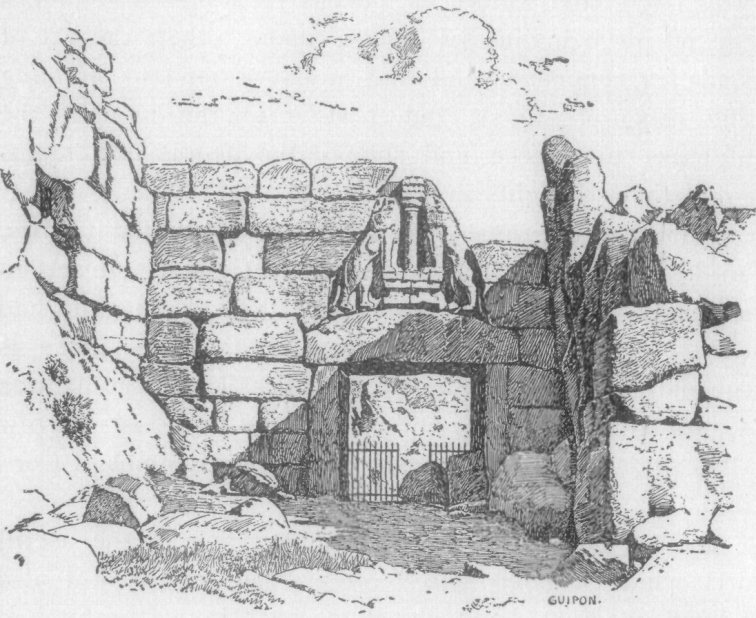
The Lion Gate, Mycenæ.
 The descendants of Danaus long ruled over the land; and one member of his family, Per´seus, built the town of My-ce´næ on a spot where many of the Pelasgian stone walls can still be seen.


 The Pelasgians who joined this young hero helped him to build great walls all around his town. These were provided with massive gateways and tall towers, from which the soldiers could overlook the whole country

DEUCALION, the early king of Thesaly told the people of the great flood . That  Deucalion and his wife Pyr´rha were the only people left alive after the flood. When the waters had all gone, they went down the mountains of Dacia,


Deucallion had a son called Hellen The country was soon peopled by the children of these men, who always , and that they sprang from the race which owed its birth to this great miracle. Deucalion reigned over this people as long as he lived; and when he died, his two sons, Am-phic´ty-on and Hel´len, became king and the country was called Hellas


dacians, the people of deucalion

Deucalion and his wife Pyr´rha came over the mountains and drive some Hellasle away, do Hellen called the chiefs of all the different cities and towns to a council, to ask their advice about the best means of defense.All the chiefs obeyed the summons, and met at a place in Thessaly where the mountains approach the sea so closely as to leave but a narrow pass between. In the pass are hot springs, and so it was called Ther-mop´y-læ


war between the dacians and the hellas


/////////////////////////////////////////////////////////////
THE KINGDOM OF ASSYRIA The culture of Athura in the ancient Sumer was  of the Late Stone Age,  regarded as  an age of barbarism.  while in Egypt the pre-Dynastic prople were  eloquent and of artistic and mechanical skill, and have mathematical ability 


 In Egypt and Babylonia the soil was tilled and its fertility increased by irrigation. Wherever man waged a struggle with Nature he made rapid progress, and  the earliest great civilizations were rooted in the little fields of the Neolithic farmers. Their mode of life necessitated a knowledge of Nature's laws; they had to take note of the seasons and measure time. So Egypt gave us the Calendar, and Babylonia the system of dividing the week into seven days, and the day into twelve double hours.


Biyernes, Disyembre 9, 2016

SARGON II KING OF ASSYRIA


THE BEGINNING OF THI STORY JUST RIGHT CLICK
http://kuyareystoriesforyou.blogspot.com/2016/12/story-of-athura-and-hellas.html


SARGON  KING OF ASSYRIA
ALSO known as Sharru Kinu

Sargon II (reigned 722-705 BCE) was one of the most important kings of the Neo-Assyrian Empire as founder of the Sargonid Dynasty which would rule the empirefor the next century until its fall. He was a great military leader, tactician, patron of the arts and culture, and a prolific builder of monuments, temples, and even a city. His greatest building project was the city of Dur-Sharrukin (`Fortress of Sargon’,  which became the capital of the Assyrian Empire under his reign.

Sargon killed his younger brother  Shalmaneser V to usurp the throne (reigned 727-722 BCE). He was not the chosen heir but took the throne from his brother under circumstances which remain unclear. It is likely, however, that he orchestrated a coup after he had grown tired of what he saw as his brother’s inept reign. Like the great Sargon of Akkad (2334-2279 BCE), whom he modeled himself after, his throne name of Sargon means `true king’ which scholars have interpreted as his means of legitimizing himself following the coup. His birth name is unknown as is whatever position he held at court prior to assuming the throne. Although regions of the empire revolted when he took control, and he does not seem to have had the support of the court, Sargon II maintained the policies and strategies initiated by his father, improved the military and economy, and brought the Assyrian Empire to its greatest height politically and militarily. His reign is considered the peak of the Neo-Assyrian Empire.

2 Kings 17:3-6  Against him came up Shalmaneser king of Assyria. And Hoshea became his vassal and paid him tribute. 4 But the king of Assyria found treachery in Hoshea, for he had sent messengers to So, king of Egypt, and offered no tribute to the king of Assyria, as he had done year by year. Therefore the king of Assyria shut him up and bound him in prison. 5 Then the king of Assyria invaded all the land and came to Samaria, and for three years he besieged it. 6 In the ninth year of Hoshea, the king of Assyria captured Samaria, and he carried the Israelites away to Assyria and placed them in Halah, and on the Habor, the river of Gozan, and in the cities of the Medes.


shalmaneser V   known as Uulayu

Ululayu, the crown prince

Shalmaneser V, king of Assyria (726-722 BC)

The chosen heir of his father Tiglath-pileser III (744-727 BC), Shalmaneser V was king of Assyria and king of Babylon. But his reign lasted less than five years and ended in a succession war which brought his brother, Sargon II(721-705 BC), to power.


After Cain killed Abel and HE WAS HIDING FROM THE LORD and became vagabond” by God (Genesis 4:12), the Bible says that he “went out from the presence of the Lord and dwelt in the land of Nod” (4:16). It was in this land that “Cain knew his wife” (4:17), and it was here that his son, Enoch, was born


///////////////////////////////////////////////

Sargon II Came and Finished the Destruction of Samaria

Sargon II wasted no time in finishing the job that Shalmaneser started. At the end of 722 BC after a three year siege, Samaria fell. According to the annals of Sargon II he deported 27,290 Israelites over to the territory of Persia (II Kings 17:6) and placed other people from around his empire into the area of Samaria to populate the area. The prophet Amos wrote some powerful words in his lamentation over Israel:


"Fallen is the Virgin of Israel"

Amos 5:1-2 - 1 - Hear ye this word which I take up against you, [even] a lamentation, O house of Israel. 2 - The virgin of Israel is fallen; she shall no more rise: she is forsaken upon her land; [there is] none to raise her up.


"At the beginning of my rule, in the very first year I reigned…I set siege to and conquered Samaria…I carried away into captivity 27,290 persons who lived there; I took fifty fine chariots for my royal equipment."


The Bible records the destruction of Israel by the Assyrians:

2 Kings 17:22-23 - "For the children of Israel walked in all the sins of Jeroboam which he did; they departed not from them; Until the LORD removed Israel out of his sight, as he had said by all his servants the prophets. So was Israel carried away out of their own land to Assyria unto this day. years."


destruction of Israel by the Assyrians

SARGON the first king of Babylon


SARGON  also known was Shar Gani Sharr to the accadian language of the kingdom of Babylon, the capital city of Agade


Cain Slays Abel


LAND OF NOD WAS LOCATED EAST OF THE GARDEN OF EDEN THAT CAIN WENT WANDERING AFTER HE KILLED ABEL

=====================

SARGON - The claim of the identity of Sargon with Cain comes from the Babylonian records

Sargon was the first king of Accadian dynasty that ruled the city of Babylon 

 The fourth chapter of Genesis, states a city  by Cain in the "Land of nod," and which he "called after the name of his son Enoch," , the Babylonian city Unuk or Erech , the city built by Kain in commemoration of his son." ...

Unuk or  "Erech appears to have been one of the centers of Semitic influence in Babylonia from a very early period."

"His career began with the conquest of Erech."    Erech is called "the old city" and the "place of the settlement"


The first Adamites were presumably superhuman in both mind and body, which would account for the great ages to which they lived. We can easily imagine, therefore, how quickly Cain (divinely protected by some mysterious mark) would become the leader, teacher and absolute lord and master of an inferior race


Tubal Cain's ancestor Cain may have taken the knowledge of arts and crafts into Babylonia. The tempter had told Eve that the Fruit of the Tree of Knowledge would make her and Adam as "gods";

Huwebes, Disyembre 8, 2016

Our Lord Jesus Christ's birth


The death of Herod the Great  on  the year of Christ's birth however  Jesus was born while Herod was still living.

Herod died thirty-seven years after he was declared king by the Romans. In 714
Herod died shortly before the Passover of 750

Preceding Herod's death.  two years from the reign of Tiberius on the theory that Tiberius was contemporary ruler with Augustus for two years. But he finds difficulty in lengthening Herod's reign set. Our present era makes the birth of Christ in the year of Rome 754

Jesus was at least two or three years old when Herod slaughtered the infants in Bethlehem, . The massacre took place some months before Herod's death  which would bring the Saviour's birth back some time into the year 749

The appearance of the "star in the east"  agree in time with the slaughter of the children,since the star  looked upon as a supernatural phenomenon, and not the wise men's interpretation of a natural conjunction of planets  this conjunction  have been the bright star that led on the wise men  The Chinese records preserve the account of the appearance of a comet in the spring of 749.

The word used is aster, star, and not astron, a group of stars.
 the star first appeared to the wise men two years before their visit, and a second time on their visit to Bethlehem.

 the star is said to have stood over "where the young child was,If it were a natural star it would have kept going as they went, and would not have stopped till they stopped. Even then it would appear as far away as ever from Bethlehem. It was therefore, a miracle 


The reign of Tiberius  begin August 29, 781  "Tiberius is adopted by Augustus as his son, and colleague in empire." Tiberius reigned jointly with Augustus about two years before he assumed full control of the empire Tiberius' power was already equal to that of Augustus in the provinces two years before his death


The apostle   Luke would naturally use the provincial point of view. Taking off the two years from the joint reign of Augustus

 The age of Jesus at his entrance upon his ministry, he began to teach, was about thirty years of age."

. The census of Augustus Cæsar   Augustus inaugurated a periodical census every fourteen years from B.C. 8 
 the enrollment should have taken place according to the Jewish and not according to the usual Roman method, because Herod would wish it to be in accordance with the customs of his kingdom. So every one went to his own city.


Here is some compelling evidence of Christ's birth.


When Mary reached the age
of womanhood she was betrothed to Joseph, son
of Jacob, and a carpenter of Nazareth

  Joseph was an upright man, and a devoted Essene


THE time was nearly due for Jesus to be born, and Mary
longed to see
Elizabeth, and she and Joseph turned their faces toward the Judean hillsAnd when, upon their way, they came to Bethlehem, the day was done, and
t    they must tarry for the night.
Bethlehem was thronged with people going to Jerusalem;
the inns and
homes were filled with guests, and Joseph and his wife could find no place to rest
but in a cave where animals were kept; and there they slept
 At midnight came a cry,A child is born in yonder cave among the beasts
  the promised son of man was born
 And strangers took the little one and wrapped him in the dainty robes that
Mary had prepared and laid him in a trough from which the beasts of burden
fed. 
 Three persons clad in snow    Three persons clad in snow  white robes came in and stood
                            before the childand said

  "ALL STRENGTH, ALL WISDOM 
      ALL LOVE BE YOURS EMMANUEL"


Now, on the hills of Bethlehem were many flocks of sheep with shepherds guarding them

 The shepherds were devout, were men of prayer, and they were waiting for atrong deliverer to come.
       
And when the child of promise came, a man in snow white robe appeared to
them, and they fell back in fear. The man stood forth and said

 FEAR NOT.. BRING YOU THE JOYFUL NEWS AT MIDNIGHT... EMMANUEL WAS BORN 

The shepherds came with haste to Bethlehem and to the cave, that they might see and honor him whom men had called Immanuel

THIS WAS HAPPENED DURING THE TIMES....WHEN
AUGUSTUS Caesar reigned and Herod Antipas was ruler of Jerusalem

  Three provinces comprised the land of Palestine: Judea, Samaria and Galilee


-----